Talent Acquisition · 2026
Harvard Resume for Recruiters
Recruiting hiring is metrics-first. The Harvard format makes your time-to-fill, offer-accept rate, and pipeline numbers travel together on one page.
How do I write a Recruiters resume in the Harvard format?
Recruiting is one of the few roles where the hiring manager reads resumes for a living — so a vague recruiter resume gets caught instantly. TA leaders at scaled companies and agencies scan for funnel ownership: reqs closed, time-to-fill, offer-accept rate, source-of-hire mix, and which ATS and sourcing stack you actually drove. The Harvard format forces the compression that lets your numbers and your stack sit in the top third of one page.
What recruiters look for
- Full-cycle vs. coordinator vs. sourcer clearly framed — and req volume to match (e.g. 15-20 open reqs at a time)
- Hard funnel metrics: time-to-fill, offer-accept rate, sourced-to-hire conversion, pipeline-to-onsite ratio
- ATS named explicitly — Greenhouse, Lever, Workday, Ashby, SmartRecruiters — plus how you configured or reported in it
- Sourcing stack: LinkedIn Recruiter, hireEZ, SeekOut, Gem, plus Boolean / x-ray depth for hard-to-fill roles
- Domain specialization (technical, GTM/sales, exec, healthcare, high-volume) or deliberate generalist range
- Certs that signal rigor: LinkedIn Certified Professional Recruiter, AIRS CIR/CDR, SHRM-CP/PHR for in-house TA
Required sections, in this order
Header and positioning
- Add an optional one-line title: e.g. "Technical Recruiter · Full-cycle · 12 reqs avg" so volume and focus read in 2 seconds
- Include LinkedIn URL on the contact line — for a recruiter, a thin profile is a credibility hit
- No photo, DOB, or marital status; a recruiter who keeps PII off their own resume signals they know hiring compliance
Experience bullets — own the funnel
- Lead each role with scope: req volume, level (IC vs. exec), and function recruited (eng, sales, clinical)
- Pair an activity with an outcome — "sourced X" is weak unless paired with hires made and time-to-fill
- Name the ATS and sourcing tools inside bullets, not just a Skills list, so they read as lived experience
- Include one bullet on process or program work (referral program, interview-panel training, DEI sourcing) — it separates recruiters from coordinators
Skills and metrics block
- Group tools: ATS · Sourcing · CRM/Outreach · Assessment so a TA lead can skim your stack instantly
- Quantify a career-level stat near the top: total hires made, cumulative reqs closed, or avg offer-accept rate
- List specialties (e.g. backend eng, AE/SDR, VP-level, RN/clinical) so the resume self-routes to the right team
Sample in Harvard format
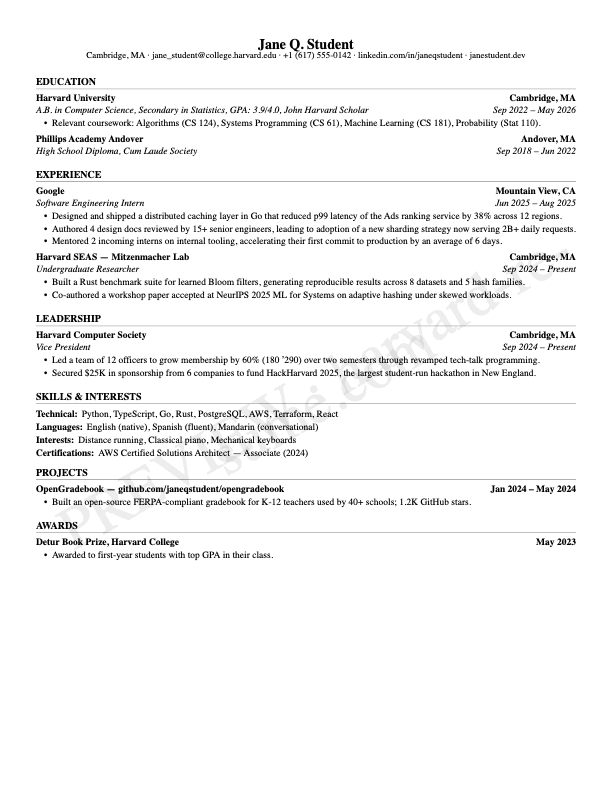
Strong vs weak bullets
Responsible for recruiting candidates and filling open positions
Owned full-cycle recruiting for 18 concurrent engineering reqs in Greenhouse, closing 47 hires in 12 months at a 41-day average time-to-fill (team avg 58) and an 84% offer-accept rate
Names the funnel scope (18 reqs), the ATS (Greenhouse), the volume (47 hires), and three hard metrics benchmarked against the team. A TA leader infers a top performer in 4 seconds.
Used LinkedIn and other tools to source candidates for hard roles
Built passive-candidate pipelines for staff-level ML roles using LinkedIn Recruiter Boolean and hireEZ x-ray search, lifting sourced-to-onsite conversion from 9% to 23% and cutting agency spend by $140K in one fiscal year
Specifies the tools and technique, the candidate tier (staff ML), the conversion metric moved, and a dollar-quantified business outcome (agency savings).
Improved the candidate experience and interview process
Redesigned the technical interview loop and trained 22 hiring-panel interviewers on structured scorecards, raising candidate-experience NPS from 41 to 72 and cutting interview-to-offer cycle time by 6 days
Turns soft process work into measurable program impact — interviewers trained, NPS moved, cycle time cut — which is what separates a senior recruiter from a scheduler.
Hit my hiring targets every quarter
Delivered 112% of quarterly hiring plan across 4 consecutive quarters (134 of 120 planned hires) while improving quality-of-hire (90-day retention) from 88% to 96%
Quantifies attainment against plan AND quality — volume without retention is a red flag, so pairing the two signals a recruiter who hires people who stay.
Mistakes specific to this role
- Listing duties ("sourced candidates," "scheduled interviews") with no funnel numbers. Recruiters reading your resume expect the same metrics they'd demand from a candidate report.
- Claiming "full-cycle" with no req volume or hires made. If you can't put a number on it, a TA lead assumes coordinator-level work.
- A Skills list of every ATS ever touched. List the 2-3 you genuinely drove and show them inside Experience bullets.
- Omitting offer-accept rate or quality-of-hire. Closing reqs fast means nothing if offers get declined or hires churn in 90 days.
- A bare or outdated LinkedIn profile. You sell candidates on it daily — a weak one on your own resume undercuts everything.
Your résumé starts here. Pay later.
Start composingFrequently asked
- Should I list time-to-fill if mine is higher than industry average?
- Only with context. If you recruited exec or staff-level roles, a 70-day time-to-fill is excellent — frame it with the difficulty tier. For high-volume or coordinator roles, lead with offer-accept rate or hires-per-month instead.
- Agency vs. in-house — does the resume change?
- Yes. Agency recruiters should emphasize placements, billing/revenue, and client retention; in-house recruiters should emphasize req closure, hiring-manager satisfaction, and program work like referral or DEI sourcing. Pick the metrics the target side cares about.
- How do I show impact if I was a sourcer, not full-cycle?
- Lead with top-of-funnel metrics: profiles sourced, response/reply rate on outreach, sourced-to-onsite conversion, and pipeline handed to recruiters that converted to hires. A sourcer who can quantify pipeline quality is highly hireable.
- Are recruiting certifications worth listing?
- Yes, the rigorous ones. AIRS (CIR, CDR), LinkedIn Certified Professional Recruiter, and SHRM-CP/PHR for in-house TA all signal seriousness. List them under a short Certifications line — never pad the resume with low-bar badges.