Healthcare · 2026
Harvard Resume for Registered Nurses
From bedside RN to charge nurse — what nurse recruiters and Magnet hospitals actually scan before the interview.
How do I write a Registered Nurses resume in the Harvard format?
Nurse recruiters and clinical managers at hospital systems, Magnet-designated facilities, and travel agencies screen for hard credentials first: an active RN license, BLS/ACLS, your specialty, and the EHR you charted in. In the first 10 seconds they confirm you can be put on a unit safely and legally. The Harvard one-page format pushes exactly those signals — license, certifications, education — into the top third, then backs them with quantified bedside outcomes recruiters can verify.
What recruiters look for
- Active RN license with state, license number, and NLC/compact status
- Current certifications: BLS, ACLS, PALS, plus specialty (CCRN, CEN, OCN, RNC-OB, CNOR)
- Named specialty and unit type (ICU, ED, Med-Surg, L&D, PACU, telemetry) with acuity level
- EHR / charting systems used: Epic, Cerner (Oracle Health), Meditech
- Quantified care: patient-to-nurse ratios, HCAHPS scores, CLABSI/CAUTI/fall reductions, readmission impact
- BSN (or RN-to-BSN in progress) — most Magnet hospitals require or strongly prefer it
Required sections, in this order
Licensure & Certifications — make it the second block, not buried
- Create a dedicated Licenses & Certifications section directly under Education; list license type, state, number, and expiration
- Note Nurse Licensure Compact (multistate) status — it is decisive for travel and multi-state systems
- Order certs by relevance to the role: specialty cert first (CCRN, CEN), then ACLS/PALS, then BLS
- No photo, no date of birth, no marital status — a U.S. clinical résumé never includes these
Clinical Experience — lead each role with the unit's acuity and ratio
- Open every position with facility type, bed/unit size, and patient ratio (e.g. '20-bed Level I Trauma ICU, 2:1 ratio')
- State the EHR you charted in and any protocols you owned (sepsis bundle, rapid response, stroke alert)
- Quantify outcomes you influenced: HCAHPS, infection rates, fall rates, door-to-balloon or door-to-needle times
- Cut generic duties ('administered medications', 'monitored vital signs') — every RN does these; they waste the page
Education & Header — keep it one page, BSN forward
- Education first in Harvard style: BSN/ADN, school, graduation year; add RN-to-BSN 'expected 2027' if in progress
- Contact line: name, phone, professional email, city/state — and your active RN license can sit here or in its section
- Drop the objective statement; use the freed space for a quantified clinical bullet instead
- One page for up to ~10 years; only seasoned nurses with publications/leadership go to two
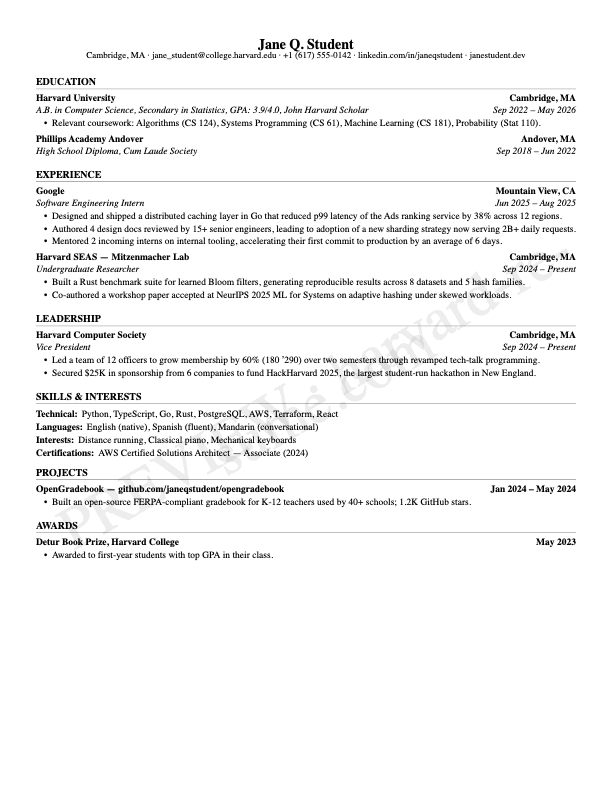
Sample in Harvard format
Strong vs weak bullets
Provided care to patients in a busy ICU and worked as part of a team
Delivered care for a 2:1 patient load in a 24-bed Level I Trauma ICU on Epic; led unit adoption of an updated sepsis bundle that cut average time-to-antibiotics from 64 to 38 minutes across 300+ septic admissions/year
Names the acuity (Level I Trauma ICU), the ratio (2:1), the EHR (Epic), and a verifiable clinical metric (time-to-antibiotics, volume). A nurse manager pictures you safely on the floor in seconds.
Helped improve patient satisfaction scores on the unit
Championed hourly-rounding and bedside-handoff practices on a 32-bed med-surg unit, lifting unit HCAHPS 'communication with nurses' from the 61st to the 88th percentile over three quarters
HCAHPS is the metric hospital leadership is judged on. A named domain, a percentile delta, and a timeframe turn a soft claim into a precise, checkable outcome.
Precepted new nurses and helped with orientation
Precepted 11 new-graduate RNs through a 12-week residency; redesigned the telemetry orientation checklist, reducing first-year turnover on the unit from 24% to 9% across two cohorts
Preceptorship is hard to quantify, but this lands it: 11 nurses, a concrete artifact (the checklist), and a retention number CNOs care about deeply because turnover costs ~$50K per RN.
Worked to reduce infections on the floor
Co-led a CLABSI-reduction initiative as unit champion, standardizing central-line dressing changes and daily necessity reviews; drove the ICU to 412 consecutive CLABSI-free days and a 71% reduction in line infections year-over-year
CLABSI is a CMS-reportable quality measure tied to reimbursement. The streak count plus the year-over-year percentage signals a nurse who moves the metrics that protect a hospital's funding.
Mistakes specific to this role
- Omitting your license number, state, and compact status. Recruiters cannot move your file forward without confirming you can legally work the unit.
- Listing routine duties every RN performs ('took vitals', 'gave meds') instead of outcomes. It signals task-level, not impact-level, nursing.
- Leaving off the EHR you charted in. Epic vs. Cerner proficiency is a real onboarding-cost factor and is often a hard filter.
- Burying certifications at the bottom. BLS/ACLS/specialty certs are pass/fail gates — put them under Education, never on page two.
- Letting it run to two pages with a fluffy objective. One tight page with quantified bullets reads as the more clinically disciplined candidate.
Your résumé starts here. Pay later.
Start composingFrequently asked
- Should I put my RN license number on my résumé?
- Yes — include the license type, issuing state, number, and expiration, plus compact (multistate) status. Recruiters verify it on Nursys before scheduling an interview, and it's standard on a U.S. nursing résumé.
- I'm a new-grad nurse with only clinical rotations. What do I put?
- Lead with your BSN and certifications, then a Clinical Rotations section: list each rotation's unit, facility, hours, and one quantified takeaway. Capstone/preceptorship hours and your NCLEX pass count as real experience.
- Do I list every certification, even expired ones?
- List only current, role-relevant certs with expiration dates. Drop expired ones and anything irrelevant to the posting — a CCRN matters for an ICU role; a phlebotomy cert from years ago usually doesn't.
- How do I show floating or travel assignments without it looking like job-hopping?
- Group travel contracts under one 'Travel RN' heading with the agency, then list each assignment as a sub-line with facility, unit, and dates. It reframes short stints as intentional, high-acuity flexibility.