Agile Delivery 2026
Scrum Master Resume (Harvard Format)
A Harvard-format resume for Scrum Masters who run delivery, not ceremonies.
How do I write a Scrum Master Resume (Harvard Format) resume in the Harvard format?
A strong Scrum Master resume proves you move metrics, not just facilitate stand-ups. Hiring managers want evidence you cut cycle time, raised predictability, and coached teams through real impediments and dependencies. Use the Harvard one-page discipline to show outcomes across squads, release trains, and stakeholders, not a list of Agile buzzwords.
What recruiters look for
- Certifications stated precisely: PSM I/II (Scrum.org), CSM/A-CSM (Scrum Alliance), SAFe SPC or SSM, ICP-ACC, or Kanban (KMP)
- Delivery metrics: sprint velocity stability, cycle time, lead time, throughput, sprint goal hit rate, escaped-defect rate, predictability %
- Scaling fluency: SAFe ART/PI Planning, LeSS, Nexus, or Scrum@Scale, plus number of squads and engineers facilitated
- Tooling depth: Jira/Jira Align, Azure DOps Boards, Rally, Linear, Confluence, Miro, and flow/dashboard reporting (burndown, CFD)
- Coaching impact: team maturity shifts, impediment removal time, dependency resolution, and stakeholder/PO alignment
- Domain context: regulated (fintech/health), platform, or product teams, plus team size (e.g., 2 squads, 14 engineers)
Required sections, in this order
Lead with delivery outcomes, not ceremonies
- Open each bullet with the result (predictability, cycle time, on-time release) before the activity, so recruiters see impact in the first 6 words.
- Quantify the team you served: number of squads, engineers, and the cadence (2-week sprints, quarterly PI) so scope is unambiguous.
- Tie facilitation to a metric: a retro that cut escaped defects, a refinement change that stabilized velocity, a dependency board that unblocked a release.
- Avoid 'facilitated daily stand-ups' on its own; pair every ceremony with the outcome it produced.
Show scaling and stakeholder range
- Name the framework precisely (SAFe 6.0, Nexus, Scrum@Scale) and your role in PI Planning or cross-team sync, not just 'used Agile'.
- Quantify dependencies you coordinated across teams and the reduction in cross-team blockers or wait time.
- Show Product Owner and leadership partnership: backlog health, sprint goal clarity, and how you protected the team from scope churn.
- Include the reporting you owned: flow dashboards, CFDs, predictability reports surfaced to directors or RTEs.
Format for the one-page Harvard standard
- One page, reverse-chronological, no photo, no objective; lead with a tight skills/certs line including PSM/CSM with issuing body.
- Use consistent past-tense action verbs (coached, facilitated, unblocked, reduced) and keep every bullet to one or two lines.
- Put certifications and tools in a dedicated section with versions (SAFe 6.0, Jira Align) so ATS keyword matching succeeds.
- Cut generic Agile mantras; reserve space for metrics, team size, and named frameworks and tools.
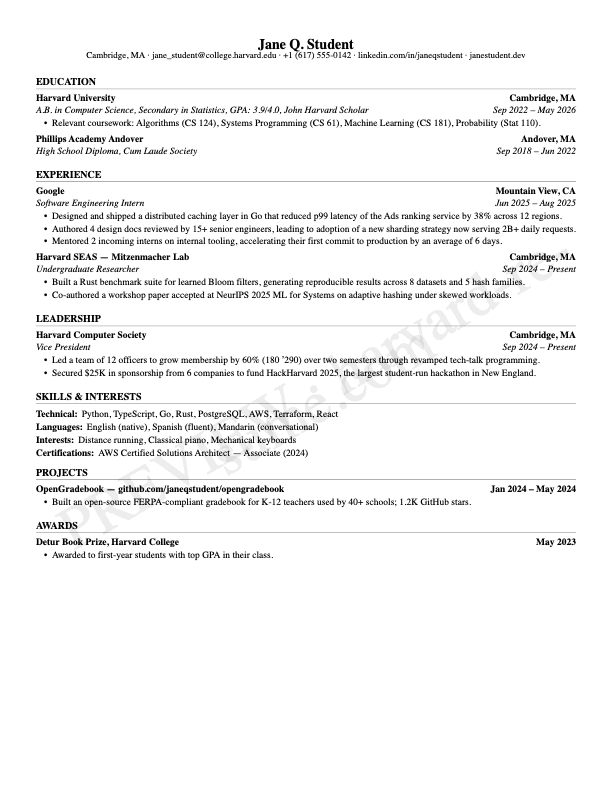
Sample in Harvard format
Strong vs weak bullets
Facilitated all Scrum ceremonies for the development team.
Raised sprint predictability from 62% to 91% across 2 squads (14 engineers) over 4 quarters by restructuring backlog refinement and enforcing a 2-week sprint goal commitment in Jira.
Names the metric, baseline-to-target, team size, cadence, the lever, and the tool.
Helped remove blockers so the team could deliver faster.
Cut average impediment resolution time from 5.2 to 1.8 days by building a cross-team dependency board in Jira Align and running a twice-weekly Scrum-of-Scrums, unblocking a delayed payments release.
Quantifies the impediment metric, the mechanism, the scaling ritual, and the business outcome.
Worked with the Product Owner on the backlog.
Reduced mid-sprint scope changes by 40% over 6 sprints by coaching the Product Owner on Definition of Ready and instituting a story-slicing standard, stabilizing velocity within a +/-10% band.
Shows PO coaching with a quantified churn reduction and a concrete velocity-stability result.
Participated in SAFe PI Planning sessions.
Facilitated PI Planning for a 5-team ART (47 engineers) in SAFe 6.0, increasing program predictability to 85% and resolving 90% of cross-team dependencies before sprint 1 via a shared Miro dependency map.
Names the framework version, ART scale, the planning event, and two quantified program-level outcomes.
Mistakes specific to this role
- Listing ceremonies ('ran stand-ups, retros, plannings') with no metric, scale, or outcome attached.
- Omitting the issuing body and level of certifications (writing 'Scrum Master cert' instead of 'PSM II, Scrum.org').
- Claiming 'increased velocity' as a goal — velocity is a planning tool, not a KPI; recruiters expect predictability, cycle time, or quality metrics instead.
- Hiding team scope: never stating how many squads, engineers, or what cadence you supported.
- Overflowing past one page with generic Agile philosophy instead of named tools, frameworks, and quantified delivery results.
Your résumé starts here. Pay later.
Start composingFrequently asked
- Which Scrum Master certifications should I put on a Harvard-format resume?
- List them precisely with the issuing body and level: PSM I or II (Scrum.org), CSM or A-CSM (Scrum Alliance), SAFe SSM or SPC (Scaled Agile), ICP-ACC (ICAgile), or KMP (Kanban University). Put them on a single certifications line near the top so ATS and recruiters catch them in seconds. Avoid vague phrasing like 'certified Scrum Master' without the source.
- Should I include velocity numbers on my resume?
- Be careful. Velocity is a team-internal planning measure and is not comparable across teams, so a raw 'velocity of 45' means little. Instead quantify predictability (committed vs delivered), velocity stability (kept within a +/-10% band), cycle time, or sprint goal hit rate. These show delivery health rather than output volume.
- How do I show impact if I never wrote code?
- Scrum Masters are judged on flow and team outcomes, not commits. Quantify cycle time and lead time reductions, impediment resolution time, predictability improvements, escaped-defect rate, and dependency or blocker reductions. Attach each to the team size and cadence so the scope is clear.
- Scrum Master or Agile Coach — how should I frame my level?
- If you served a single team, emphasize team-level coaching and delivery metrics. If you facilitated multiple squads, an ART, or org-wide transformation, surface scaling frameworks (SAFe, Nexus, Scrum@Scale), the number of teams, and program predictability — that range is what signals an Agile Coach or senior Scrum Master.