Marketing · 2026
Harvard Resume for SEO Specialists
A search lead wants traffic that converts and rankings you actually moved — not 'optimized keywords.' Your Harvard one-pager has to prove you grew a number.
How do I write a SEO Specialists resume in the Harvard format?
SEO Specialist roles are screened by heads of growth, content directors, and organic-acquisition leads who scan for one thing: did you move organic traffic, rankings, or pipeline — and can you prove it. They want the stack (GA4, GSC, Ahrefs or Semrush, Screaming Frog), evidence you fixed technical issues at scale (Core Web Vitals, crawl budget, indexation), and content that earned positions for revenue keywords. The Harvard one-page format forces you to drop 'optimized for search engines' and lead every bullet with a measured organic result.
What recruiters look for
- Organic growth you can defend: non-branded organic sessions/clicks, YoY traffic lift, keyword positions gained (top-3 or page-1), and organic-attributed conversions or revenue in GA4
- Concrete stack fluency: Google Search Console, GA4, Ahrefs or Semrush, Screaming Frog, Sitebulb, Google Tag Manager, and Looker Studio for reporting
- Technical SEO depth: Core Web Vitals (LCP, INP, CLS), crawl-budget and indexation fixes, log-file analysis, structured data/schema.org, hreflang, and canonical hygiene
- Content and link proof: published briefs that ranked, topic-cluster or pillar strategy, and earned/built links with referring-domain growth — not 'managed content'
- Reporting and forecasting: building organic dashboards in Looker Studio, traffic/revenue forecasting, and tying SEO to MQLs or pipeline finance can defend
- Credentials and signals: Google Analytics (GA4) certification, Semrush/Ahrefs Academy, a personal site or case study that ranks, and familiarity with SGE/AI Overviews
Required sections, in this order
Lead with a Results-First Experience block
- Put Experience high under Education and open every bullet with the metric: '+118% non-branded organic,' '240 keywords into top-3,' '0.9s faster LCP' — never 'Responsible for SEO.'
- Title each role by scope: 'SEO Specialist — Technical & Content (3.2M monthly sessions, 14-country hreflang)' tells a reviewer your level and surface area instantly.
- Group bullets by lever — technical, content, links, reporting — so a hiring lead can map you to the gap they're filling in seconds.
- Cut anything you can't quantify or defend; a vague 'improved SEO' bullet burns credibility on a one-pager where every line competes for space.
Make Skills a real stack, not buzzwords
- List the tools you actually operate, grouped: Analytics (GA4, Looker Studio, GSC), Research (Ahrefs, Semrush), Technical (Screaming Frog, Sitebulb, GTM, log-file analysis), CMS (WordPress, Webflow, Next.js).
- Name the SEO disciplines you own end-to-end (technical audits, on-page, content strategy, internationalization, link building) so the role's primary need jumps out.
- Add credentials inline — Google Analytics (GA4), Semrush Academy, Ahrefs certification — as fast trust signals and ATS keyword matches.
- Drop filler ('detail-oriented,' 'passionate about search'); the bullets prove those, and the Harvard one-page format has no room for vibes.
Keep Education and format Harvard-clean
- Education first with degree, institution, graduation year, and GPA only if 3.5+ or recent; a marketing, communications, or CS background all read fine for SEO.
- No photo, no date of birth, no full address — a city/metro line keeps the ATS and the reviewer locked on your organic results.
- One page, reverse-chronological, consistent tense, single clean font — and quantify side projects (a blog or niche site you grew) in one tight line with the traffic figure.
- If you have a ranking case study or personal site, add one line with the metric ('grew niche site to 90K monthly organic sessions') — proof beats claims.
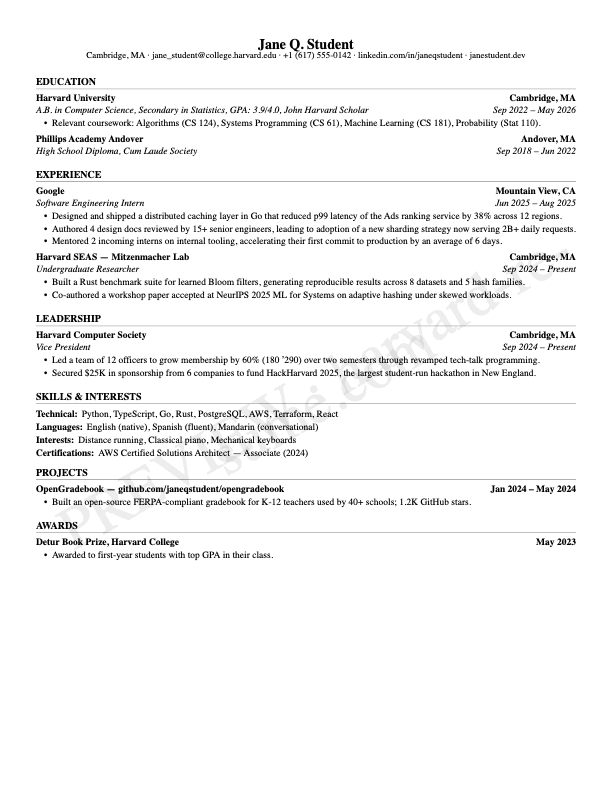
Sample in Harvard format
Strong vs weak bullets
Optimized website content and keywords to improve search engine rankings.
Grew non-branded organic traffic 118% YoY (210K→458K monthly sessions) by shipping a 40-page topic cluster targeting bottom-funnel keywords, lifting 240 terms into top-3 and adding $310K in organic-attributed revenue.
Names the lever (topic cluster), the traffic figure YoY, the ranking outcome, and ties it to revenue — 'improve rankings' alone proves nothing to a growth lead.
Worked on technical SEO and fixed site issues to help performance.
Cut LCP from 3.4s to 1.6s and INP from 280ms to 90ms across 12K templated pages via image lazy-loading and a CDN edge-cache rollout, moving 68% of URLs into 'Good' Core Web Vitals and recovering 22% of lost mobile rankings.
Specifies the exact CWV metrics, the scale of pages, the technical fix, and the ranking recovery — it shows a technical SEO who diagnoses and ships, not just audits.
Helped build backlinks and improve the site's authority.
Ran a digital-PR and broken-link campaign that earned 140 referring domains (DR 40+) in two quarters, growing the site's referring-domain count 47% and pushing 18 commercial pages from page 2 to page 1 in Ahrefs.
Replaces 'authority' with referring-domain growth, link quality (DR), and a concrete ranking movement — it proves the links drove positions, not just a vanity metric.
Created SEO reports and tracked our keyword performance over time.
Built a Looker Studio organic dashboard blending GA4, GSC, and Ahrefs that cut monthly reporting from 6 hours to 20 minutes and surfaced a cannibalization issue whose fix recovered 31K monthly clicks across 90 URLs.
Quantifies the time saved, names the data sources stitched together, and shows the dashboard drove a real fix with a click figure — reporting as a business outcome, not a chore.
Mistakes specific to this role
- Leading bullets with tasks ('Responsible for on-page optimization') instead of organic outcomes — recruiters want the traffic, ranking, or revenue you moved.
- Reporting only total organic traffic. Separate branded from non-branded; non-branded is the number that proves your SEO work, not existing brand demand.
- Vanity metrics with no business link — keyword counts, impressions, or 'Domain Rating' mean little without sessions, conversions, or revenue attached.
- Claiming you 'do all of SEO.' Depth wins: prove you owned technical, content, or links and moved a number, rather than a shallow list of everything.
- Spilling onto a second page with tool logos and jargon. The Harvard one-pager is a forcing function — if a bullet has no metric, cut it.
Your résumé starts here. Pay later.
Start composingFrequently asked
- How do I quantify SEO impact if I don't have access to revenue data?
- Use the closest defensible number you do have: non-branded organic sessions or clicks from GSC, keyword positions gained (top-3 or page-1), organic conversions or sign-ups in GA4, and indexation or Core Web Vitals improvements. A YoY traffic figure plus a ranking-count delta already proves impact without needing the P&L.
- Should I list every SEO tool I've used on a one-page resume?
- No — group the ones you actually operate into a compact Skills block (GA4, GSC, Ahrefs/Semrush, Screaming Frog, Looker Studio). A wall of tool names reads as padding; depth in two or three (technical, content, or links) with results in the bullets is far more convincing to a screener.
- How do I show technical SEO versus content SEO experience?
- Frame each role to the job you're targeting. For a technical role, foreground Core Web Vitals, crawl budget, log-file analysis, schema, and hreflang; for a content role, foreground topic clusters, briefs that ranked, and organic conversions. The Harvard one-pager lets you re-sequence bullets per application without rewriting your history.
- Does AI Overviews / SGE change what I should put on my SEO resume?
- It raises the value of proving you adapt. Add a line if you've optimized for AI Overviews, featured snippets, or entity/structured-data coverage, and frame results around qualified organic conversions rather than raw clicks. Showing you protected or grew conversions as SERPs changed signals you're current, not stuck in 2019 tactics.