Social & Content · 2026
Harvard Resume for Social Media Managers
Social hiring is portfolio-plus-numbers. The Harvard format makes engagement rate, follower growth, and paid ROAS travel together on one page.
How do I write a Social Media Managers resume in the Harvard format?
Social media hiring is unusually evidence-hungry. Recruiters at agencies, DTC brands, and in-house marketing teams spend their first scan looking for proof you moved real numbers — follower growth, engagement rate, ROAS, and content velocity — not a list of platforms you 'managed.' The Harvard format suits this role because it forces every line into the accomplished-X-by-Y-doing-Z shape, which is exactly how channel performance should be reported.
What recruiters look for
- Channel-level metrics named explicitly: engagement rate (ER%), reach, follower growth, saves/shares, watch-through rate — not 'grew the social presence'
- Paid social fluency: Meta Ads Manager, TikTok Ads, LinkedIn Campaign Manager with real ROAS / CPM / CPA figures and budget managed
- Tooling depth: scheduling/analytics stacks (Sprout Social, Later, Hootsuite, Buffer), creator tools (CapCut, Canva, Adobe Premiere), and listening (Brandwatch, Talkwalker)
- Content velocity and format range: posts/week shipped, short-form video volume, UGC and creator/influencer programs run
- Certifications that signal rigor: Meta Blueprint, Google Analytics (GA4), HubSpot Social Media, Hootsuite Platform / Social Marketing
- Community and crisis judgment: response-time SLAs, sentiment shift, and how a negative moment was handled
Required sections, in this order
Header & portfolio framing
- Add a one-line tagline under your name if useful: e.g. 'Social Media Manager · DTC & Beauty · 5 yrs'
- Link a portfolio of your best work (a Notion page, a deck, or a public profile that shows real posts and the numbers behind them) as a contact-line entry after email
- No photo, no DOB — even though your job is visual, the résumé stays Harvard-clean
- List handles only if you grew them and the numbers are impressive; a 400-follower account is a credibility hit
Experience bullets — lead with the channel and the metric
- Open each role naming the brand's scale (follower base, audience size, vertical) so the reader calibrates difficulty
- Separate organic outcomes (ER%, follower lift, reach) from paid outcomes (ROAS, CPA, budget) — recruiters scan for both
- Include one bullet on community/crisis work, not just growth: response time, sentiment, or how you defused a negative moment
- Tie social to revenue or pipeline where you can: attributed sales, sign-ups, or qualified leads from social
Skills section — be testable, not buzzwordy
- Platforms with depth, not a logo wall: Instagram, TikTok, LinkedIn, YouTube Shorts, X — only the ones you actually ran
- Tools: Meta Ads Manager, Sprout Social, Later, GA4, CapCut, Canva, Brandwatch — list what you can be interviewed on
- Certifications: Meta Blueprint, GA4, HubSpot Social Media, Hootsuite — with year if recent
- Skip empty phrases like 'strong storytelling' and 'passionate about social'; replace with a campaign or format you owned
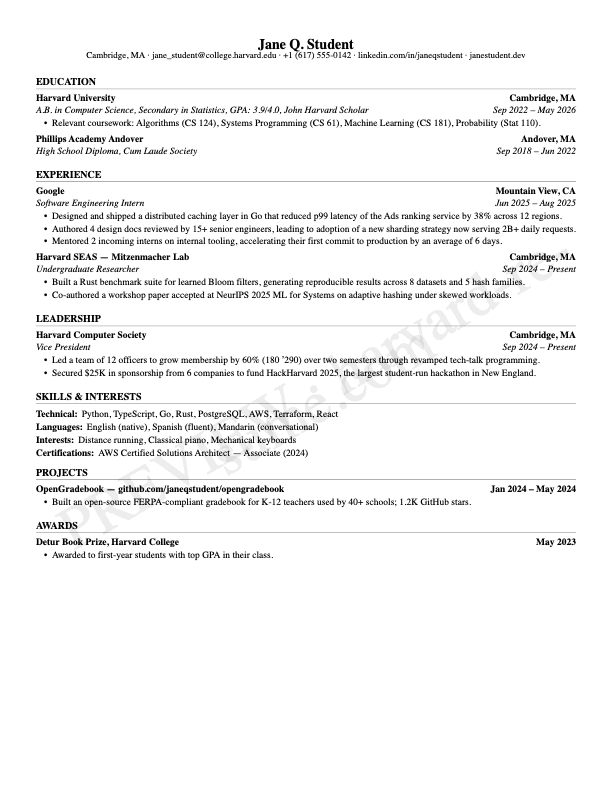
Sample in Harvard format
Strong vs weak bullets
Managed the company's Instagram and grew the following
Grew Instagram from 18K to 112K followers in 11 months for a DTC skincare brand by shifting to a 5x/week Reels-first calendar and a weekly UGC series, lifting average engagement rate from 1.9% to 6.4% and driving 3,200 attributed product page sessions/month
Names the platform, the absolute and relative growth, the timeframe, the strategy (Reels-first, UGC cadence), the ER% delta, and a downstream business metric. A reviewer infers a real operator, not a poster, in four seconds.
Ran paid social campaigns to drive sales
Managed a $640K annual paid social budget across Meta and TikTok Ads, building a creative-testing framework of 30+ ad variants/month that improved blended ROAS from 2.1x to 4.3x and cut cost-per-acquisition by 38% over two quarters
Quantifies budget scale, names the platforms, shows process (creative testing volume), and reports the two metrics paid recruiters care most about — ROAS up, CPA down — with the time window.
Built a TikTok presence from scratch
Launched the brand's TikTok channel from zero to 240K followers and 9.1M organic views in 6 months, producing and editing 4 short-form videos/week in CapCut; converted the audience with a creator program of 22 micro-influencers that generated $180K in tracked GMV
Shows a 0-to-1 build with concrete volume (4 videos/week), the views and follower scale, hands-on production (CapCut), and a revenue outcome from the influencer layer — breadth and depth on one line.
Handled community management and responded to comments
Owned community management across 5 channels for a 900K-follower audience, cutting average first-response time from 9h to 47min via a tiered triage playbook and shifting net sentiment from -8% to +21% during a product-recall moment
Turns soft 'replied to comments' work into hard signals: channel count, audience scale, response-time SLA, and a sentiment swing during a genuine crisis — exactly the judgment senior roles screen for.
Mistakes specific to this role
- Listing platforms with no numbers attached. 'Managed Instagram, TikTok, LinkedIn' tells a recruiter nothing — every channel needs a growth, ER%, or ROAS figure beside it.
- Reporting vanity metrics only. Follower counts without engagement rate, reach, or revenue read as inflated; pair every follower number with a quality metric.
- Hiding paid social experience. If you ran ad budgets, name the spend, platforms, and ROAS — paid fluency is a major differentiator and most candidates bury it.
- Confusing 'posted content' with 'drove outcomes.' Lead bullets with the result (sales, leads, ER lift), then the activity (calendar, format, cadence) — not the other way around.
- Linking a portfolio that's a dead Linktree or a private account. Recruiters will click; a 404 or a locked profile costs you the interview.
Your résumé starts here. Pay later.
Start composingFrequently asked
- Should I list my personal social handles on a social media manager résumé?
- Only if they demonstrate the skill you're selling. A creator account with 50K+ engaged followers, strong ER%, or a niche you've built is real proof — list it. A near-empty personal account undercuts you, so leave it off and link a work portfolio instead.
- How do I quantify social work when I didn't have access to revenue data?
- Use the metrics you did own: engagement rate, follower growth (absolute and %), reach/impressions, saves and shares, watch-through rate, response time, and content velocity (posts or videos per week). 'Lifted ER from 1.9% to 6.4%' is fully quantified without revenue access.
- Which certifications actually carry weight for this role?
- Meta Blueprint and Google Analytics (GA4) are the most recognized; HubSpot Social Media and Hootsuite Platform/Social Marketing are useful, especially for junior-to-mid roles. List them under Skills or a short Certifications line with the year if earned in the last two years.
- Do I need a separate section for the brands or campaigns I've worked on?
- Usually no — keep it to one page and fold standout campaigns into your Experience bullets. A separate 'Selected Campaigns' block only earns its space if you've led 3+ named launches with metrics that wouldn't fit under your roles.