Social Services · 2026
Harvard Resume for Social Workers
From MSW intern to LCSW — what hospitals, child-welfare agencies, and nonprofits actually scan for.
How do I write a Social Workers resume in the Harvard format?
Social-work hiring is licensure-gated and mission-driven. HR teams at hospitals, county child-welfare agencies, school districts, VA medical centers, and community nonprofits scan three things in the first 8 seconds: your license (LMSW/LCSW and state), your MSW and its CSWE accreditation, and your practice setting. The Harvard one-page format puts exactly those in the top third — credentials before narrative — so a hiring manager confirms you can legally bill and supervise before reading a single bullet.
What recruiters look for
- License + state spelled out (LCSW, LMSW, LSW, or 'MSW, license-eligible') and clinical supervision hours logged toward independent licensure
- CSWE-accredited MSW with concentration (clinical, macro, child & family) and field-placement hours (typically 900+ for advanced standing)
- Practice setting named: medical/hospital, child welfare/CPS, school, behavioral health, hospice, substance use, case management
- EHR and assessment tools by name: Epic, Cerner, biopsychosocial assessments, PHQ-9, GAD-7, ASI, Columbia Suicide Severity Rating Scale (C-SSRS)
- Evidence-based modalities: CBT, DBT, motivational interviewing, trauma-informed care, crisis de-escalation, Safety Plan / SAFE-T
- Quantified impact: caseload size, discharge or reunification rates, no-show reduction, days-to-placement, grant dollars secured
Required sections, in this order
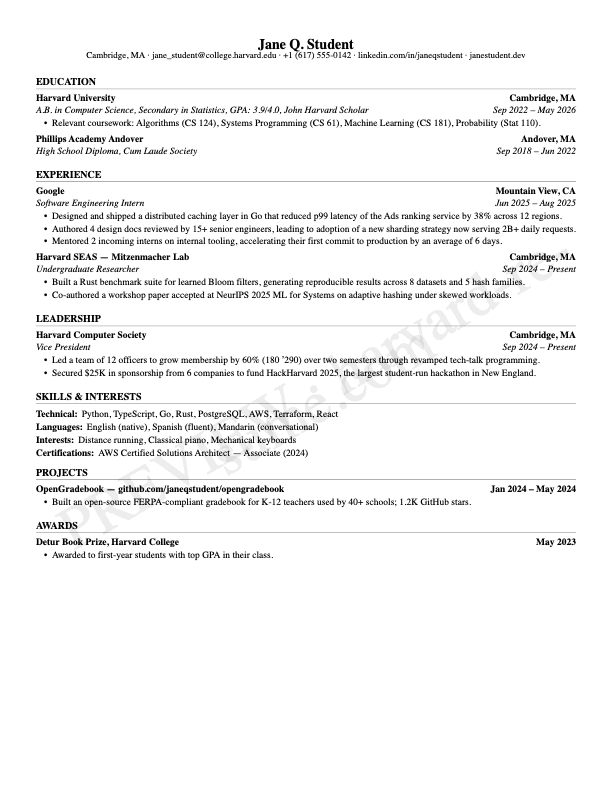
Lead with licensure and education
- Put a Licensure line directly under your name: 'LCSW #XXXXX (CA) · LMSW (NY) · CPR/BLS' so it is legible before Experience
- Education first, Harvard-style: MSW (concentration) and BSW/BA, with 'CSWE-accredited' and graduation year; new grads add field-placement hours and GPA if ≥3.5
- List supervision toward independent license ('logged 2,400 of 3,000 clinical hours under LCSW supervision') — agencies need to know how close you are
- No photo, no DOB, no marital status — even though client-facing, the résumé stays credential-forward
Frame experience around caseload and outcomes
- Open each role with setting and population: 'Inpatient oncology, 18-bed unit' or 'Child Protective Services, 90-county region' so scale is instant
- Quantify the caseload — number of active clients, families, or students — and the throughput (intakes/month, discharges, home visits)
- Tie bullets to measurable outcomes the agency tracks: readmission, reunification, placement stability, ED utilization, treatment completion
- Separate Clinical/Direct Practice from Macro/Program work if you do both, so a clinical manager and a program director each see their fit
What to cut and what to add
- Cut soft generalities ('passionate about helping people') — every social worker is; lead with what you carried and moved
- Add a tight Skills line: modalities, assessments, EHR, languages spoken (bilingual Spanish is a hiring multiplier), and crisis certifications (CPI, ASIST, QPR)
- Add Field Education as its own block if you are new-grad — placements are real experience and recruiters read them as a first job
- Keep it one page through LCSW; only seasoned macro/clinical directors with publications justify a second page
Sample in Harvard format
Strong vs weak bullets
Provided case management services to clients and helped them access resources.
Managed a rolling caseload of 42 high-acuity behavioral-health clients, completing biopsychosocial assessments and warm handoffs that lifted treatment-plan completion from 61% to 88% over 9 months.
Names the caseload size, the acuity, the assessment tool, and a tracked outcome with a baseline. A hiring manager infers you can carry volume AND move a metric in 4 seconds.
Worked with families in the child welfare system to improve outcomes.
Carried 28 active CPS cases across a 6-county region, conducting weekly home visits and coordinating reunification plans that raised 12-month placement stability from 70% to 91% and cut average days-to-permanency by 38.
Quantifies caseload, geography, visit cadence, and two child-welfare KPIs (placement stability, days-to-permanency) that CPS supervisors are measured on themselves.
Helped reduce hospital readmissions through discharge planning.
Led discharge planning for an 18-bed inpatient oncology unit in Epic, building post-acute care and transportation plans that reduced 30-day readmissions from 19% to 11% across ~240 discharges per quarter.
Anchors the setting, the EHR, and a CMS-penalized metric (30-day readmission) with volume and a percentage-point drop. Reads as a medical social worker who understands value-based care.
Ran groups and provided therapy to clients dealing with substance use.
Facilitated 6 weekly DBT and motivational-interviewing groups for 50+ clients in intensive outpatient, using C-SSRS at every intake; group attendance no-shows fell from 32% to 14% over two quarters.
Names the modalities, the validated risk screen (C-SSRS), the census, and an engagement metric. Signals evidence-based, safety-conscious practice rather than vague counseling.
Mistakes specific to this role
- Burying or omitting your license and state. The license is the first thing screened — if HR can't confirm you're LCSW/LMSW in their state in the top inch, the résumé stalls.
- Writing duties, not outcomes. 'Provided supportive counseling' is a job description; agencies hire on caseload moved, readmissions cut, families reunified, hours logged.
- Hiding clinical supervision hours. Agencies hiring license-eligible MSWs need to know how many of your independent-licensure hours are already logged — make it a line, not a guess.
- Listing every training certificate you've ever attended. Recruiters trust depth — keep 4-6 modalities and assessments you can actually be supervised and tested on (CBT, DBT, MI, C-SSRS, trauma-informed care).
- Omitting EHR and bilingual ability. Epic/Cerner fluency and spoken Spanish are concrete filters in medical and community settings — leaving them off costs you keyword matches and interviews.
Your résumé starts here. Pay later.
Start composingFrequently asked
- Where do I put my LCSW/LMSW license on a Harvard-format résumé?
- On a credential line directly beneath your name, before Experience — e.g. 'Jane Doe, LCSW · #XXXXX (CA) · CPR/BLS'. Repeat it in Education or a Licensure block with state and number. Recruiters confirm you can legally practice and bill before reading anything else.
- I'm a new MSW grad with only field placements. How do I fill a one-page résumé?
- Treat field education as employment. Give each placement its own block with the setting, population, supervisor's credential, hours completed (e.g. 900), and 2-3 quantified bullets (caseload, assessments completed, groups run). Keep Education first and you'll fill a strong, honest page.
- Should I list every population and setting I've worked with?
- No — tailor to the posting. If you're applying to a hospital, lead with medical/discharge work and Epic; for CPS, lead with child-welfare KPIs and home-visit caseloads. One focused page beats a scattered list across geriatrics, schools, and substance use.
- How do I show outcomes when my work is qualitative and confidential?
- Use aggregate, de-identified metrics agencies already track: caseload size, no-show and engagement rates, readmission or reunification percentages, treatment-completion rates, days-to-placement, and grant dollars secured. No client detail required — just the numbers your program reports up the chain.