Cloud & Enterprise Architecture · 2026
Harvard Resume for Solutions Architects
Your résumé is an architecture decision record: ship business outcomes and trade-offs, not a logo wall of every AWS service.
How do I write a Solutions Architects resume in the Harvard format?
Solutions Architects are hired by cloud platform teams, pre-sales orgs, and enterprise modernization programs that scan your résumé for one thing first: did your designs move a business metric — revenue, cost, latency, or risk — at real scale? The Harvard one-page format forces you past a checklist of every AWS, Azure, and GCP service into the decisions you owned: the migration you led, the TCO you cut, the SLA you defended, and the trade-offs you chose. Lead with quantified architecture outcomes, keep certs (AWS/Azure/GCP Solutions Architect, TOGAF) tight under Education, and write every bullet like an ADR with a measured result.
What recruiters look for
- Quantified architecture outcomes: TCO reduced (cut 3-year cloud spend 34%, $1.2M), p99 latency (480ms → 90ms), uptime SLA defended (99.99%), migration scope (180 servers, 40 apps)
- Named cloud depth with scale: AWS/Azure/GCP services tied to a workload — EKS clusters, Aurora throughput, event-driven designs on Kafka/Kinesis/EventBridge, not a flat service list
- Pre-sales and stakeholder signals: solution proposals or RFPs won ($ value), Well-Architected / Cloud Adoption Framework reviews led, reference architectures and HLDs authored
- Migration and modernization evidence: lift-and-shift vs re-platform vs re-architect decisions, monolith-to-microservices, data-center exit, hybrid/landing-zone design
- Cost and reliability engineering: rightsizing, reserved/savings plans, multi-AZ/region DR, RTO/RPO targets met, FinOps guardrails set
- Role-gating certifications: AWS Certified Solutions Architect (Associate/Professional), Azure Solutions Architect Expert, Google Professional Cloud Architect, TOGAF 9/10
Required sections, in this order
Lead with Architecture Outcomes, Not a Service Catalog
- Put a tight Experience section first after Education; open each role's bullets with the business or reliability outcome (TCO cut, latency, SLA, revenue enabled), not the cloud provider
- State the design scale inside the bullet — '180 servers, 40 apps, 3 regions' or 'event-driven design at 2M events/day' — so a reviewer sees your blast radius and seniority instantly
- Cap a grouped 'Technical Skills' footer (Cloud / Compute & Containers / Data & Messaging / IaC / Security) so an ATS keyword-matches without a 40-service soup
- Show the decision, not just the deployment: 're-platformed instead of lift-and-shift to cut DB licensing $300K/yr' proves architectural judgment, the core of the role
Make Certifications & Education Work Harvard-Style
- Education first, one line each: degree, institution, graduation year — no GPA unless above 3.5 and recent
- List active, role-gating certs (AWS SA Professional, Azure SA Expert, Google Professional Cloud Architect, TOGAF) under Education with issuer and year earned
- Drop expired Associate certs once you hold the Professional tier, and cut deprecated vendor badges that signal stale, pre-cloud architecture
- If you came from engineering, lead with the systems you designed and migrated — the Harvard format rewards measured outcomes over title progression
One Page, ATS-Clean, Decision-Driven
- No photo, no DOB, no diagrams or skill bars — a reference architecture belongs in your portfolio link, not as graphics that ATS parsers shred
- Single column, standard fonts, no tables or text boxes — multi-column architecture résumés often parse into garbage and drop your keywords
- Spell the concept then the acronym once: 'Total Cost of Ownership (TCO)', 'high-level design (HLD)' so both keyword variants match
- Reverse-chronological, strong action verbs (Architected, Migrated, Consolidated, Re-platformed) — every bullet carries a number and a trade-off or it gets cut
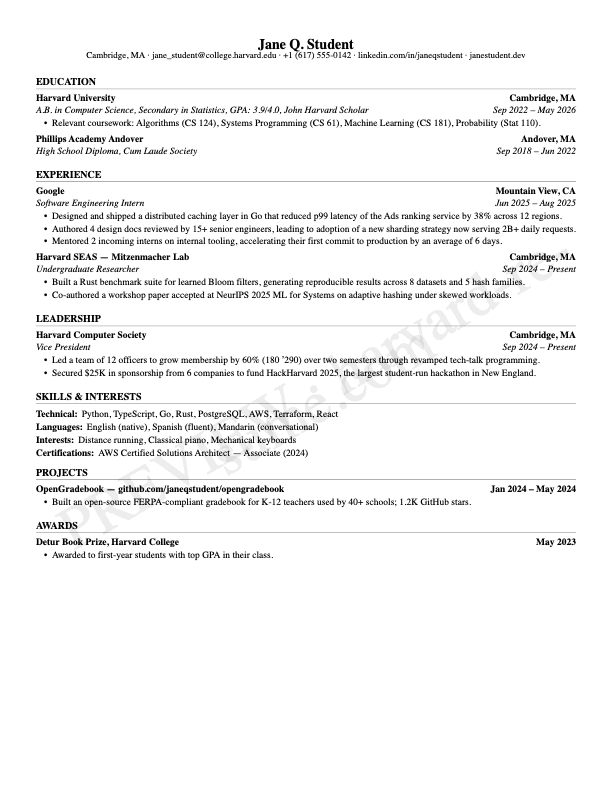
Sample in Harvard format
Strong vs weak bullets
Worked on migrating the company's applications to AWS.
Architected and led the migration of 40 on-prem applications (180 servers) to AWS using a landing-zone and re-platform strategy, cutting 3-year TCO 34% ($1.2M) and hitting a 4-hour RTO with multi-AZ Aurora and cross-region DR.
Names the strategy (landing-zone, re-platform), the scale (40 apps, 180 servers), the dollar outcome (TCO and amount), and a reliability target (RTO). Reads as senior architectural ownership.
Designed a new microservices architecture for the platform.
Re-architected a checkout monolith into 12 event-driven microservices on EKS and EventBridge, sustaining 2.3M orders/day and cutting p99 checkout latency from 480ms to 90ms with zero-downtime cutover behind a feature-flagged traffic shift.
Specifies the pattern (event-driven), the stack (EKS, EventBridge), the throughput (2.3M/day), the latency metric, and the rollout discipline (zero-downtime, feature flag).
Helped the sales team win cloud deals with solution designs.
Authored reference architectures and HLDs for 18 enterprise RFPs, winning $4.6M in annual contract value, including a Well-Architected review that surfaced $280K/yr of rightsizing savings and closed a stalled financial-services deal.
Ties architecture to revenue ($4.6M ACV), counts the deals (18 RFPs), and shows a concrete pre-sales lever (Well-Architected review, $280K savings) that closed a deal.
Reduced cloud costs and improved reliability across the environment.
Cut Azure spend 29% ($540K/yr) by consolidating 9 redundant data services onto a single Synapse and Cosmos DB design, while lifting platform uptime from 99.9% to 99.99% through multi-region failover and an RPO of 5 minutes.
Dollars and percent, the consolidation decision (9 → 1 design on named services), uptime nines, and a recovery-point target — cost and reliability proven together, not vaguely 'improved'.
Mistakes specific to this role
- Listing 40+ cloud services as a flat keyword wall. Architects are judged on judgment — group 5-6 categories and pair each headline service with a workload and a metric.
- Describing deployments instead of decisions ('migrated to AWS'). The role is trade-offs: say why you chose re-platform over lift-and-shift and what it saved in dollars, latency, or risk.
- Hiding the scale and the money. 'Designed a scalable system' is filler; '2.3M orders/day, p99 90ms, $1.2M TCO cut' proves the level you operate at.
- Keeping expired Associate certs or pre-cloud vendor badges. Once you hold AWS SA Professional or Azure SA Expert, the lapsed ones signal stale architecture, not depth.
- Stretching to two pages with implementation minutiae. Harvard discipline is one page — if a bullet has no business metric and no architectural choice, it's an engineer's task, not an architect's, so cut it.
Your résumé starts here. Pay later.
Start composingFrequently asked
- Should I list every cloud service I've used, or just the ones I architected with?
- Just the ones you architected with and can defend. A flat wall of 40 services reads as shallow and clutters ATS matching. Group 5-6 categories (Cloud, Compute & Containers, Data & Messaging, IaC, Security) and pair your headline services with a real workload and metric. One AWS/EKS/Aurora event-driven design you genuinely owned outperforms a logo soup every time.
- How do I quantify Solutions Architect work when I don't write most of the code?
- Your metrics are business and system outcomes, not commits. Quantify TCO cut ($ and %), migration scope (servers, apps, regions), p99/p95 latency, uptime SLA and RTO/RPO, throughput (events or orders per day), and pre-sales impact (RFPs won, ACV). These are exactly what cloud and pre-sales hiring managers scan for first — they measure the design, not the typing.
- Which certifications matter most for a Solutions Architect résumé?
- The role-gating ones: AWS Certified Solutions Architect (Associate, then Professional), Azure Solutions Architect Expert, and Google Professional Cloud Architect for hands-on cloud roles, plus TOGAF 9/10 for enterprise-architecture tracks. Put current certs under Education with issuer and year. Drop the Associate once you hold the Professional, and cut deprecated or pre-cloud badges that signal stale skills.
- Should pre-sales and proposal work go on a Solutions Architect résumé?
- Yes — for customer-facing and pre-sales architect roles it's a top signal. Quantify RFPs and proposals won, annual contract value influenced, reference architectures and HLDs authored, and Well-Architected or Cloud Adoption Framework reviews led. It proves you translate technical design into business outcomes, which separates an architect from a senior engineer in a hiring manager's eyes.