Founders · 2026
Harvard Resume for Startup Founders
VC pitch decks, accelerator applications, and acqui-hire conversations all start with a founder résumé. Harvard format compresses your story into one page.
How do I write a Startup Founders resume in the Harvard format?
Founder résumés are unusual because the audience is variable: a YC partner reading 500 applications in a weekend, a seed VC scanning before a first meeting, an acquirer's HR after a wind-down, or a future co-founder evaluating your track record. The Harvard format compresses across all four audiences — it puts the company, the traction, and the team you built in the first 30 seconds.
What recruiters look for
- Company name, role (Co-founder / CEO / CTO), and dates
- Traction metrics (ARR, MAU, paying customers, growth rate)
- Capital raised by round (pre-seed, seed, Series A) with lead investors
- Team size at peak (FTE count, eng count separately)
- Outcome — current status (acquired by X, wound down, still operating)
Required sections, in this order
Experience customisation
- Lead each company with: company name + 1-line description + role + dates
- Two-line summary per company before bullets (traction snapshot + outcome)
- Bullets cover: distribution wins, product shipping pace, team-building moments, fundraising milestones
Failed ventures
- Include them honestly — accelerators and investors value pattern recognition
- One-line cause (PMF never reached, market timing, co-founder conflict, capital ran out)
- What you learned in 1 specific bullet (process change you'd make in V2)
Education section
- Lead with the most recent degree, but include MBA / undergrad institution
- School affiliations matter for accelerator filters (YC slightly favours Stanford/MIT/Ivy alumni; Techstars more open)
- If a famous dropout (started/sold company while in school), state it: 'Withdrew Sept 2023 to focus on Acme full-time'
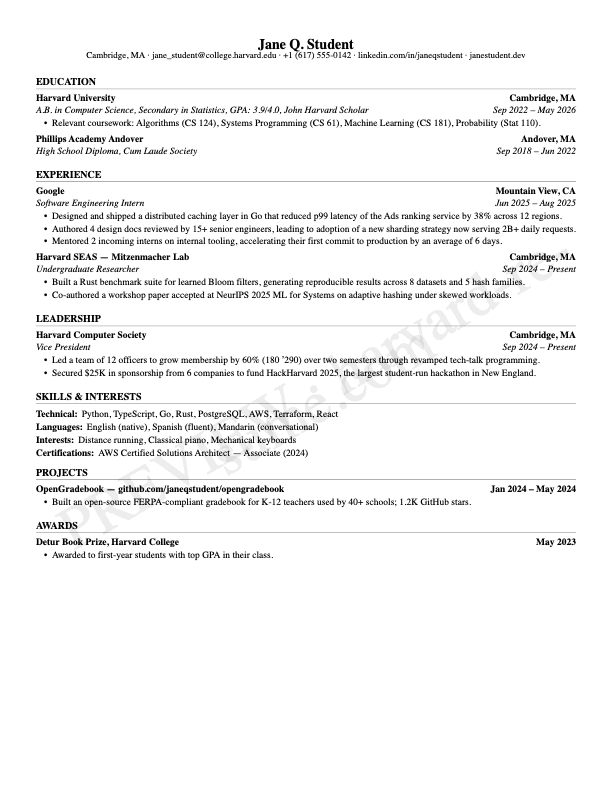
Sample in Harvard format
Strong vs weak bullets
Founded a SaaS company in the marketing analytics space
Co-founder & CEO, Datacard (B2B marketing analytics SaaS, 2022-2025): grew from $0 → $2.1M ARR across 84 paying customers in 30 months; raised $4.8M seed led by Benchmark with participation from Khosla; team scaled to 11 FTE (7 eng, 2 sales, 1 design, 1 ops)
Specific category, dates, ARR + customer count, round + lead investor, team composition. A YC partner reads all that in 8 seconds.
Sold the company to a larger competitor
Negotiated and closed acquisition by HubSpot (closed Aug 2025, undisclosed terms — accretive to HubSpot's marketing analytics product line per their Q3 earnings call); led 14-month transition serving as Director of Product Analytics
Names the acquirer, references public corroboration (Q3 earnings call), and shows the post-deal narrative (you stayed and integrated rather than vanishing).
Built a previous company that didn't work out
Co-founder, Mealhub (B2C meal-planning app, 2020-2021): reached 12K MAU and $48K ARR but never crossed unit-economics threshold (CAC > $80 vs LTV $54); wound down June 2021, returned 60% of capital to investors; learning: validated TAM before scaling acquisition spend
Specific metrics (MAU, ARR, CAC, LTV), honest cause, capital-returned signal (= integrity), and the lesson stated specifically. Investors prefer this to a hidden failure.
Mistakes specific to this role
- Inflating ARR using contracted-but-not-billed numbers. Investors check.
- Listing 'serial entrepreneur' as a tagline. Show the serial part with multiple companies on the timeline.
- Omitting failed ventures entirely. Investors discover them in due diligence and lose trust.
- Generic skills like 'leadership' or 'strategic thinking'. Replace with: 'recruited 4 of 7 first eng hires from cold outreach' style specifics.
Your résumé starts here. Pay later.
Start composingFrequently asked
- Should I list myself as a serial founder if I have 2 companies?
- Use the timeline to show it — don't claim 'serial founder' as a tagline. Two founded companies on the résumé makes the point.
- How do I handle ongoing companies on the résumé during fundraising?
- Use 'present' for the end date and add the current ARR / MAU / customer count as the most recent bullet. Investors expect the latest numbers.
- Do investors care about pre-startup work experience?
- Only the parts that signal pattern-recognition (e.g., 'former PM at Stripe — saw how the payments stack scales' for a fintech founder). Don't include unrelated jobs from college.