Statistics · 2026
Harvard Resume for Statisticians
Hiring teams want to see study design rigor, the right method for the data, and validated results they can defend to a regulator or a board. Harvard format puts your methods and impact in the same frame.
How do I write a Statisticians resume in the Harvard format?
Statistician hiring splits across three lanes that read very differently: biostatistics (clinical trials, FDA/EMA submissions, CDISC), applied/industry statistics (experimentation, forecasting, causal inference), and government/survey statistics (sampling design, official estimates). A hiring manager at a CRO scans for SAS, SDTM/ADaM, and submission experience; a tech analytics lead scans for A/B test design and R/Python; a federal agency scans for survey methodology and disclosure rules. The Harvard one-page format lets you lead with the design and the method, then prove you moved a real number — power, precision, error rate, or dollars.
What recruiters look for
- Study/experiment design fluency — sample size and power calculations, randomization, stratification, pre-registered analysis plans
- Method-to-data fit: GLMs, mixed-effects/longitudinal models, survival (Cox, Kaplan-Meier), Bayesian methods, causal inference (propensity scores, DiD, IV)
- Tooling depth: SAS (incl. PROC MIXED/PHREG/GLIMMIX), R (tidyverse, lme4, survey, brms), Python (statsmodels, scikit-learn), Stan/JAGS, SQL
- Regulatory and standards literacy where relevant: CDISC SDTM/ADaM, ICH E9/E9(R1) estimands, GCP, 21 CFR Part 11; or for gov: survey weighting, variance estimation, disclosure avoidance
- Reproducibility and validation: version control (Git), documented SAPs, double-programming/QC, literate analysis (R Markdown/Quarto)
- Communication of uncertainty to non-statisticians — confidence intervals, effect sizes, and assumptions stated, not just p-values
Required sections, in this order
Track selection — pivot the same skeleton
- Biostatistics: surface a Submissions/Trials line under Experience (phase, indication, regulatory outcome); list CDISC and ICH literacy in Skills
- Applied/industry: lead Experience with experiment-design and business-metric bullets; foreground A/B testing and causal inference
- Government/survey: name the survey program and methods (sampling frame, weighting, variance estimation, disclosure avoidance) in your bullets
- New grad: Education first with thesis/methods focus; add a Selected Coursework line only if it names graduate methods (e.g., Survival Analysis, Bayesian Inference)
Skills section content (only what you can defend)
- Methods: mixed-effects & longitudinal, survival analysis, Bayesian inference, causal inference, multiple-imputation for missing data, GLMs
- Software: SAS, R, Python, Stan/JAGS, SQL — list the specific PROCs/packages you've actually run, not a textbook index
- Standards (track-dependent): CDISC SDTM/ADaM, ICH E9(R1) estimands, GCP/21 CFR Part 11; or survey weighting + variance estimation
- Reproducibility: Git, Quarto/R Markdown, double-programming/QC, Docker/renv for environment control
Bullet construction with Harvard XYZ
- State the design before the result: 'powered at 90% to detect a 0.4 SD difference' tells a reviewer you sized the study, not just ran it
- Quantify the right axis for your role — power, precision (CI width), Type I/II error, MAPE, lift, or dollars — not generic 'improved accuracy'
- Name the method and the data scale: 'mixed-effects model on 18,400 repeated measures' beats 'analyzed data'
- Close the loop: tie the analysis to a decision (regulatory filing, product launch, published estimate, policy change)
Sample in Harvard format
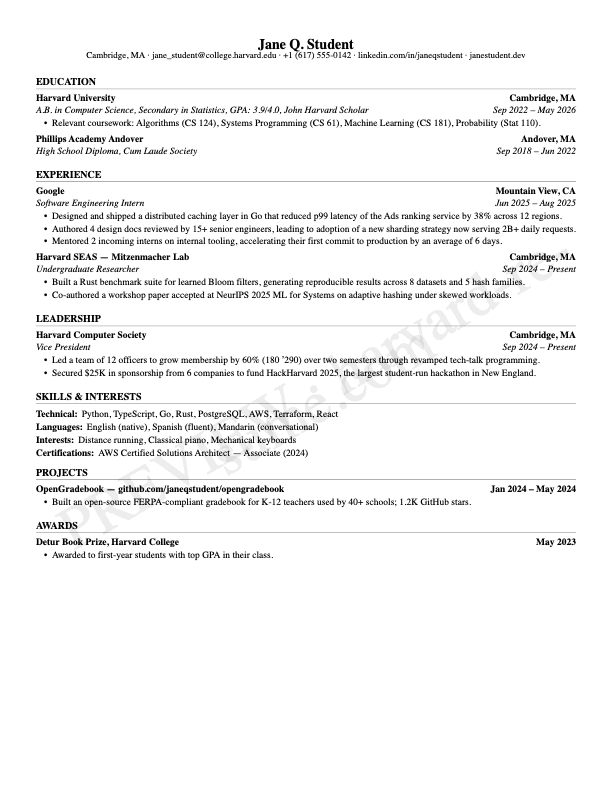
Strong vs weak bullets
Analyzed clinical trial data and produced statistical reports
Served as lead statistician on a Phase III randomized trial (n=842, 2 arms, stratified by site); authored the SAP and ran the primary mixed-effects repeated-measures analysis in SAS (PROC MIXED), delivering submission-ready ADaM datasets and TLFs that supported a successful FDA NDA filing
Names the phase, design, sample, the standard (SAP/ADaM), the exact tool (PROC MIXED), and the regulatory outcome (NDA filing) — a biostat reviewer infers full study ownership.
Worked on A/B tests for the product team
Redesigned the experimentation platform's analysis layer using sequential testing (always-valid p-values) and CUPED variance reduction in R; cut median experiment runtime from 21 to 9 days and reduced required sample size ~35% across 140+ tests/quarter
Names the methods (sequential testing, CUPED), the language, and two quantified axes (runtime 21→9 days, ~35% sample reduction) at real scale (140+ tests/quarter).
Helped with the national survey estimates
Re-engineered the weighting and variance-estimation pipeline (raking to 6 ACS margins, replicate weights via BRR) for a 52,000-household survey in R survey; reduced design effect from 2.1 to 1.6 and cut published-estimate standard errors ~18% with no added field cost
Names the survey methodology (raking, BRR replicate weights), the scale (52K households), and quantified precision gains (DEFF 2.1→1.6, SE −18%) — exactly what a government methodologist is judged on.
Built a forecasting model for demand
Built a hierarchical Bayesian demand-forecasting model (Stan, partial pooling across 1,200 SKUs) replacing a per-SKU ARIMA baseline; lowered MAPE from 23% to 14% and reduced safety-stock holding cost by $2.1M annually
Names the method (hierarchical Bayesian, partial pooling), what it replaced (per-SKU ARIMA), and dual metrics (MAPE 23→14%, $2.1M saved) — shows both statistical and business judgment.
Mistakes specific to this role
- Leading with p-values and no effect size or confidence interval. Reviewers read 'p<0.05' as statistically illiterate framing; report the estimate, the CI, and the assumptions.
- Listing every method from a graduate syllabus. Pick the 6-8 you've actually run on real data and can be grilled on in a panel.
- Omitting study/experiment design. 'Analyzed data' with no mention of randomization, power, or sampling reads as a button-pusher, not a statistician.
- For biostat roles, hiding regulatory and CDISC experience. SDTM/ADaM, SAP authorship, and submission outcomes are the filter — surface them in the top third.
- Claiming 'SAS and R and Python and Stan' equally. Hiring managers probe the one you list first; rank them honestly by depth.
Your résumé starts here. Pay later.
Start composingFrequently asked
- Should a biostatistician résumé list specific trials and indications?
- Yes — name the phase, therapeutic area, and your role per trial (lead vs. supporting statistician), plus the regulatory outcome if public (NDA/BLA filing, approval). Respect any blinding/confidentiality: describe the design and your contribution without disclosing unblinded or proprietary results.
- How do I show statistical rigor in one line without jargon overload?
- Anchor each bullet on a design choice and a precision/error metric: 'powered at 90%', 'reduced design effect to 1.6', 'always-valid sequential p-values'. One concrete methodological term plus one quantified result signals rigor far better than a wall of acronyms.
- Do I need both SAS and R on my résumé?
- Depends on the lane. Pharma/CRO and regulatory submissions still run heavily on SAS, so it's near-mandatory there; tech, academia, and government increasingly favor R/Python. List the one your target lane uses first and demonstrate depth in it with specific PROCs or packages.
- Where do publications and a thesis go?
- If you're research-track or a new grad, put a Publications/Research section between Education and Experience and name your methodological contribution. For applied industry roles, keep it brief — one or two peer-reviewed or working papers under Education or a short Selected Publications line — and let quantified work bullets carry the rest.