Supply Chain · 2026
Harvard Resume for Supply Chain Managers
From plant planner to head of supply chain — what manufacturers, CPG, and 3PLs scan for in 8 seconds.
How do I write a Supply Chain Managers resume in the Harvard format?
Supply-chain hiring is run by numbers people. Recruiters at P&G, Unilever, Amazon, Flex, and mid-market manufacturers scan the top third for one thing: did you move cost, service level, or inventory in a quantifiable direction. The Harvard format forces that proof into the first two roles, ahead of soft-skill filler. This recipe tunes it for planners, procurement leads, logistics managers, and S&OP owners moving up into end-to-end ownership.
What recruiters look for
- APICS CPIM or CSCP certification (CLTD for logistics-heavy roles); Lean Six Sigma Green/Black Belt for ops-driven shops
- ERP/planning systems named: SAP ECC or S/4HANA (MM/PP/WM), Oracle, Kinaxis RapidResponse, Blue Yonder/JDA, o9, Coupa, Ariba
- Hard supply metrics: OTIF, fill rate, forecast accuracy/MAPE, inventory turns, DIO/DSO, freight cost per unit, PPV
- S&OP / IBP ownership — running the monthly cycle, not just attending it
- Cost-out scale: $ savings delivered, % freight reduction, working-capital freed
- Scope signals: # SKUs, # suppliers, $ spend managed, plants/DCs and regions covered
Required sections, in this order
Header & professional summary framing
- Lead the summary with scope, not adjectives: 'End-to-end supply chain leader, $180M spend, 14K SKUs, 3 DCs across LatAm'
- List certifications inline next to your name or in a Certifications line: CPIM, CSCP, PMP, Lean Six Sigma Black Belt
- No photo, no DOB; one phone, one professional email, LinkedIn — that's the whole contact block
Experience — order bullets by P&L impact
- Put cost-savings and service-level bullets first in each role; system migrations and process bullets second
- Every bullet carries a baseline and a result: 'OTIF from 87% to 96%', not 'improved OTIF'
- Name the ERP/planning tool inside the bullet, not only in Skills — proves you operated it, didn't just list it
- Quantify scope per role: SKUs, suppliers, spend, headcount managed, plants/DCs covered
Skills, certifications & education
- Group Skills: Planning (S&OP, DRP, MRP) · Systems (SAP, Kinaxis) · Methods (Lean, Six Sigma, Kaizen) · Trade (Incoterms, customs)
- List APICS/ASCM certs with status and year; 'CPIM (2024)' beats 'pursuing CPIM' with no date
- Education stays one line each; an MBA or industrial-engineering degree belongs here, GPA only if 3.5+ and recent
Sample in Harvard format
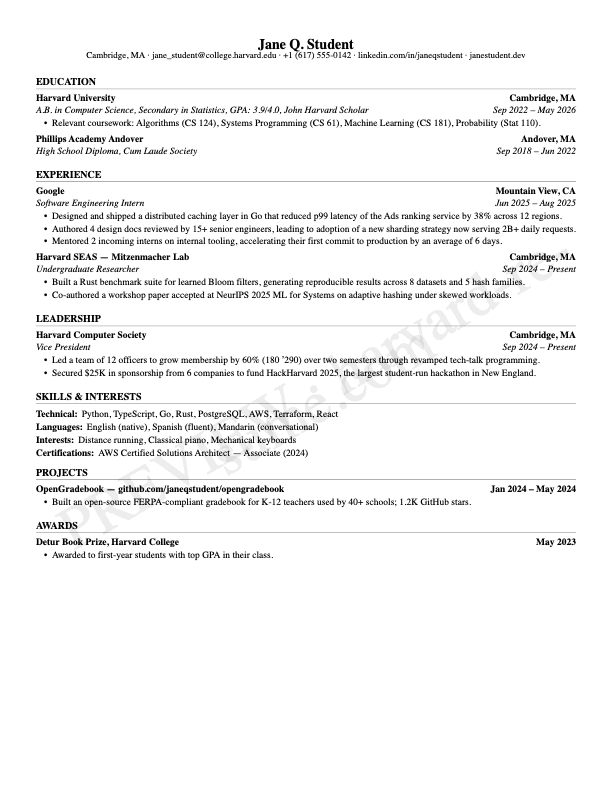
Strong vs weak bullets
Responsible for reducing logistics costs and improving delivery
Cut outbound freight cost per unit 19% ($2.4M annualized) by re-tendering 11 lanes and shifting 30% of volume from LTL to multi-stop FTL, while holding OTIF at 96% across 3 DCs
Names the lever (re-tender + LTL→FTL), the metric (cost/unit), the dollar scale ($2.4M), the guardrail held (OTIF 96%), and the footprint (3 DCs). A reviewer infers real network ownership in seconds.
Implemented a new planning system to help with forecasting
Led the SAP IBP rollout across 14K SKUs and 6 plants, lifting forecast accuracy from 62% to 78% MAPE-adjusted and freeing $5.1M in working capital by cutting DIO from 58 to 41 days
The system (SAP IBP) is tied to two outcomes — forecast accuracy and DIO — plus working capital freed. Migrations only count when they move a number.
Worked with suppliers to negotiate better contracts
Renegotiated terms with the top 25 suppliers (60% of $90M spend), delivering 7.2% purchase-price variance savings and extending payment terms from 30 to 60 days, adding $4.4M of one-time cash flow
Spend concentration (top 25 = 60% of $90M), the savings metric (PPV), and the working-capital win (terms 30→60) show a procurement leader who reads a P&L.
Improved inventory management and reduced stockouts
Redesigned safety-stock policy using a service-level model in Kinaxis, raising fill rate from 91% to 98.5% while reducing finished-goods inventory $3.2M (turns 6.1→8.4) across 4 categories
Inventory bullets are credible only when service and inventory move in opposite directions at once — fill rate up, dollars down — with the method (service-level model) and tool (Kinaxis) named.
Mistakes specific to this role
- Writing 'responsible for the supply chain' with no number. Recruiters skip any bullet without a baseline→result delta.
- Listing every ERP module ever touched in Skills but never naming a system inside an Experience bullet — it reads as exposure, not operation.
- Claiming cost savings with no scope. '$2M saved' is meaningless without the spend base or % — anchor it ($2M on $90M spend = 2.2%).
- Confusing activity with outcome: 'ran weekly S&OP meetings' is attendance; 'owned the S&OP cycle that lifted forecast accuracy 16 pts' is ownership.
- Overflowing to two pages with a decade of tactical buyer tasks. One page, last ~10 years, impact bullets only — Harvard discipline.
Your résumé starts here. Pay later.
Start composingFrequently asked
- Is APICS CPIM or CSCP worth listing if I'm still studying for it?
- List it only with a status and a realistic date — 'CSCP (expected Q3 2026)'. A vague 'pursuing certification' with no timeline reads as filler. If you hold CPIM already, put it next to your name; it's the single most recognized credential in planning roles.
- Should I quantify bullets when the numbers are confidential?
- Use percentages, ranges, or relative scale instead of absolute figures: '~20% freight reduction', '$10M+ spend', 'top-quartile fill rate'. Recruiters care about magnitude and direction, not your employer's exact P&L. Never invent numbers you can't defend in an interview.
- Planning, procurement, and logistics — do I need one résumé or three?
- Keep one master, then re-order the top three bullets of each role to match the job. A procurement role wants PPV and supplier scope first; a logistics role wants OTIF, freight cost/unit, and network design first. The Harvard format makes that re-ordering fast because impact lives at the top of each role.
- How do I show S&OP or IBP ownership without sounding generic?
- Anchor it to a cadence and an outcome: 'Owned the monthly S&OP cycle across 6 plants, closing the demand-supply gap and lifting forecast accuracy 16 pts.' Naming the cycle, the footprint, and the number that moved separates an owner from an attendee.