Accounting & Tax 2026
Tax Advisor Resume (Harvard Format)
A Harvard-format resume for tax advisors that proves you cut liabilities, survive audits, and file clean.
How do I write a Tax Advisor Resume (Harvard Format) resume in the Harvard format?
Tax advisor hiring comes down to three proofs: how much liability you legally removed, how cleanly you survived an IRS or state audit, and how many returns you filed without a penalty. A Harvard-format resume forces every line into the XYZ formula — accomplishment, metric, method — so a partner skimming for 15 seconds sees dollars saved and exposure managed, not a list of software you opened.
What recruiters look for
- Active credential: CPA, EA (Enrolled Agent), or a Master of Taxation, with the licensing state and active status noted
- Tax saved or recovered in real dollars — effective rate cuts, R&D credits, depreciation strategies, amended-return refunds
- Audit and exam experience: IRS revenue agent exams, state nexus audits, voluntary disclosures, and the resolution outcome
- Return volume and complexity: 1040/1120/1120-S/1065/990 counts, multi-state, K-1s, FBAR/FATCA, and transfer-pricing exposure
- Software fluency named explicitly: CCH Axcess, Thomson Reuters UltraTax/GoSystem, Lacerte, ProSystem fx, Drake, Alteryx, Excel modeling
- Provision and compliance work: ASC 740 tax provisions, quarterly estimates, SALT, and Section 174/199A/163(j) calculations
Required sections, in this order
Header, credentials & summary
- Lead with CPA or EA right after your name (e.g., 'Jane Park, CPA') and state the active license state — recruiters filter on it first
- Replace an objective with a 2-line summary that quantifies your niche: 'EA serving 140 high-net-worth and S-corp clients; $4.2M in legally documented tax savings over 3 seasons'
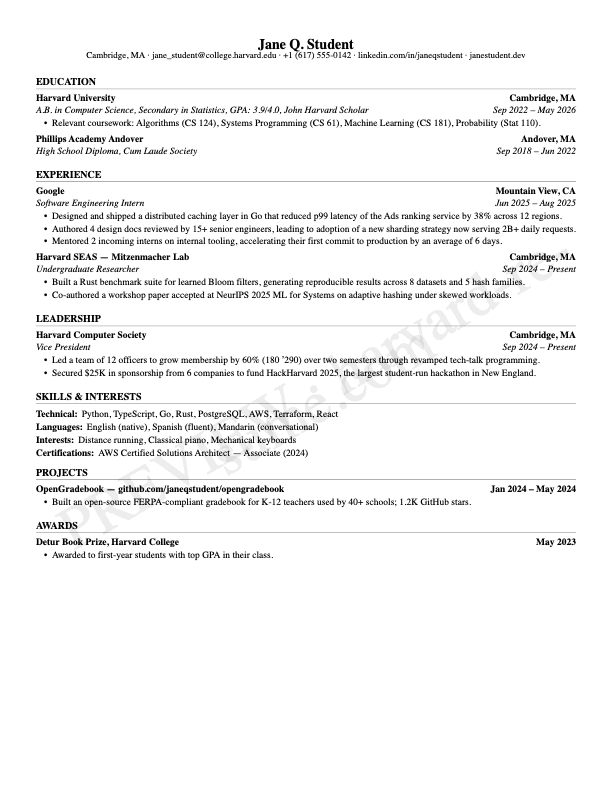
- Use one clean column, 10–11pt serif, no headshot, one page for under 10 years of experience — partners reject ornate templates as non-Harvard
- Put credentials, education, and any LL.M./MST near the top so ATS keyword-matches 'Enrolled Agent', 'Certified Public Accountant' on the first pass
Experience bullets in XYZ form
- Open every bullet with a strong verb (Reduced, Recovered, Defended, Restructured) and a hard dollar or percentage, never 'Responsible for'
- Tie each engagement to client type and entity: 'across 38 S-corp and partnership returns', 'for a $90M multi-state manufacturer'
- Name the tax mechanism — R&D credit, cost segregation, 199A QBI, 163(j) interest limitation — so reviewers see technical depth, not generic 'tax prep'
- Quantify audit outcomes: amount of proposed adjustment abated, penalty waived, or the no-change letter you secured
Skills, software & compliance
- List tax software by exact product name (CCH Axcess, UltraTax CS, Lacerte, ProSystem fx, Drake) — ATS and partners match on the platform you'll actually use
- Group technical skills: federal/state compliance, ASC 740 provision, SALT/nexus, international (FBAR, FATCA, GILTI), and Excel/Alteryx automation
- Include CE/CPE currency and PTIN status to signal you're active and audit-ready in the current filing year
- Skip soft-skill filler like 'detail-oriented' — prove it through a zero-penalty or zero-error-rate metric in your bullets instead
Sample in Harvard format
Strong vs weak bullets
Prepared tax returns for various clients and helped reduce their taxes.
Reduced effective tax rate from 31% to 22% for 12 closely-held S-corps by restructuring owner compensation and layering 199A QBI and 163(j) elections, documenting $1.8M in defensible savings across the 2025 season.
Names the entity type, the exact tax mechanisms, the rate movement, dollar impact, and the filing season — partner-grade specificity.
Handled an IRS audit for a client and it went well.
Defended a $640K proposed IRS adjustment on a multi-state manufacturer by reconstructing fixed-asset records and substantiating a cost-segregation study, securing a no-change letter and abating $190K in proposed penalties.
Quantifies exposure defended, the technical method, and a verifiable outcome (no-change letter, penalty abatement) auditors respect.
Worked on R&D tax credits for some companies.
Recovered $2.3M in federal and state R&D credits for 7 SaaS and biotech clients by leading Section 41 qualification interviews and building an Alteryx workflow that cut credit-study prep time from 40 to 12 hours per engagement.
Pairs a credit-dollar result with a process-efficiency metric and a named tool, showing both technical and operational value.
Filed a lot of returns each year on time and accurately.
Filed 310 individual and entity returns (1040, 1120-S, 1065) in CCH Axcess across two states with a zero-penalty, sub-0.5% amendment rate, while training 3 junior associates on review-ready workpaper standards.
Shows volume, entity mix, the software, a quality metric, and leadership — the full picture of a senior preparer.
Mistakes specific to this role
- Listing job duties ('prepared returns', 'met with clients') instead of quantified outcomes — every bullet must carry a dollar, percentage, or volume
- Hiding your CPA/EA credential in the education section instead of next to your name where recruiters and ATS look first
- Writing 'tax software' generically instead of naming CCH Axcess, UltraTax, Lacerte, or ProSystem fx that the firm actually runs
- Omitting audit and resolution outcomes — 'assisted with audits' wastes the line; state the adjustment abated or penalty waived
- Letting the resume sprawl to two pages with soft-skill filler; Harvard format demands one tight page proving impact
Your résumé starts here. Pay later.
Start composingFrequently asked
- Should I put CPA or EA after my name on a tax advisor resume?
- Yes. Place the active credential immediately after your name (e.g., 'Maria Ruiz, CPA') and note the licensing state. Firms and ATS filters screen on it first, and burying it in the education section is the most common reason qualified tax resumes get passed over.
- How do I quantify tax work without sharing confidential client data?
- Use aggregate and anonymized metrics: total tax saved across a client segment, effective-rate reductions in percentage points, return volume by entity type, or proposed adjustments abated. Reference client size by revenue band ('a $90M manufacturer'), never by name — that keeps it both compelling and confidentiality-safe.
- What's the single most important number on a tax advisor resume?
- Defensible dollars saved or recovered — through credits, deductions, restructuring, or audit defense — because it directly maps to the revenue and client retention a firm cares about. A close second is return volume with a clean penalty/amendment rate, which proves reliability at scale.
- Should I list every tax software I've touched?
- List the platforms you can work in productively — CCH Axcess, UltraTax CS, GoSystem, Lacerte, ProSystem fx, Drake — plus Excel and any automation tools like Alteryx. Skip software you used once; depth on the firm's actual stack matters more than a long, shallow list.