Education · 2026
Harvard Resume for K-12 Teachers
Principals scan for certification, grade band, and growth data first — the Harvard format puts all three above the fold.
How do I write a K-12 Teachers resume in the Harvard format?
K-12 hiring runs through principals, assistant principals, and district HR who screen dozens of applicants per posting against a state licensure checklist before they ever read a bullet. They scan for three things first: your active teaching license and endorsements, your grade band and subject, and evidence that students grew under you. The Harvard one-page format puts certification and education up top — exactly where a hiring committee looks — and forces every classroom accomplishment into a quantified, growth-anchored line.
What recruiters look for
- Active state teaching license + endorsements (e.g., Multiple Subject, Single Subject Math, ESL/ELL, SPED, K-6, 7-12) with license number and expiration
- Grade band and subject stated explicitly (3rd grade self-contained, 9-12 Biology, K-5 ELL) — not 'elementary educator'
- Student-growth evidence: proficiency gains, MAP/i-Ready/STAR RIT growth, AP pass rates, state assessment (SBAC/STAAR/Regents) movement
- Tools and frameworks: Google Classroom, Canvas, Schoology, IEP/504 implementation, PBIS, MTSS/RTI, UDL, differentiated instruction
- Classroom-management and culturally-responsive practice with concrete signals (referral reductions, attendance, family-engagement rates)
- Co-teaching, mentoring, curriculum, or department-lead roles that show leadership beyond your own roster
Required sections, in this order
Header & certification block
- Put a Certifications line directly under the contact line: state, license type, endorsements, number, and expiration (e.g., 'CA Single Subject — Mathematics #ABC123, exp. 2028; CLAD/ELL authorization')
- State your grade band + subject in the header or summary tagline (e.g., 'Secondary Math Teacher · Grades 9-12 · 5 yrs')
- No photo, no DOB, no marital status — even on international applications where it's common, US/most districts screen it out
Education-first, the Harvard way
- Lead with your degree(s): B.A./B.S., M.Ed. or M.A.T., institution, and credential program; list GPA only if 3.5+
- Add 'Relevant Coursework' or a thesis/capstone only if you are a new-grad or career-changer with thin classroom experience
- Surface high-signal credentials here: National Board Certification (NBPTS), Reading Specialist, BCLAD, Orton-Gillingham, AP course audit approval
Experience bullets — anchor to student outcomes
- Lead each bullet with what students did, not what you 'delivered' — growth, proficiency, pass rates, attendance
- Name the assessment and the cohort size (28 students, 3 sections of 32, 120-student caseload)
- Pair the academic metric with a method (small-group rotations, standards-based grading, data-driven small-group instruction) so it's repeatable, not luck
- Cut generic 'created a positive learning environment' lines — replace with a measured behavior or engagement outcome
Sample in Harvard format
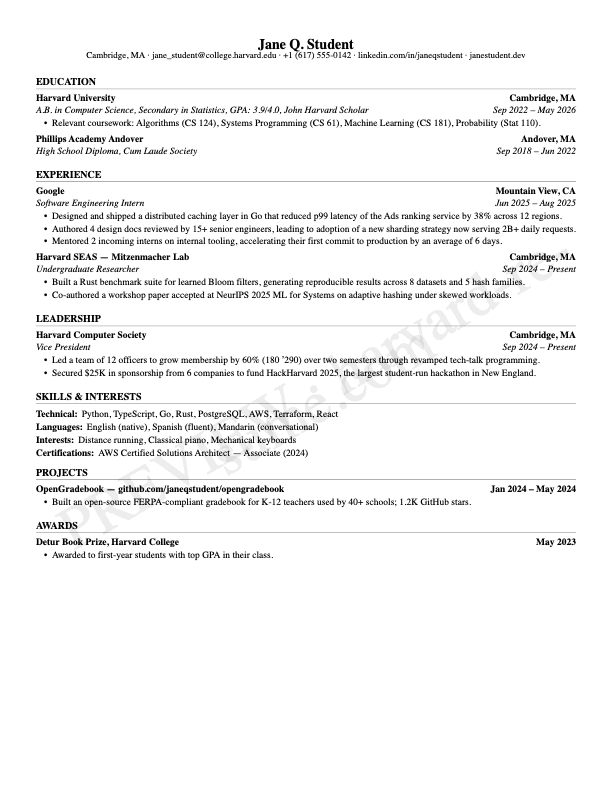
Strong vs weak bullets
Taught math to 9th and 10th grade students and helped them improve
Taught 5 sections of Algebra I (142 students) using standards-based grading and weekly small-group reteach; raised SBAC math proficiency from 41% to 63% in one year and cut the failure rate from 19% to 6%
Names the course, the load (142 students across 5 sections), the method (standards-based grading + small-group reteach), and dual metrics (proficiency +22 points, failures down 13). A principal infers a teacher who moves data on purpose, not by accident.
Worked with English language learners and special education students
Co-taught an inclusion ELA block (28 students, 9 with IEPs, 6 ELLs) with a SPED partner; designed tiered MTSS interventions that grew i-Ready reading from a median 2.1 to 3.4 grade-equivalent across the year, with 100% of IEP reading goals met
Specifies the model (co-taught inclusion), the exact composition (IEPs + ELLs), the framework (MTSS tiers), and two outcomes (i-Ready growth + 100% IEP goal attainment). It proves compliance and instructional skill in one line.
Used technology in the classroom and managed behavior well
Implemented Google Classroom and a PBIS points system across a 3rd-grade self-contained room (26 students); reduced office referrals by 71% (24 to 7) over the year and lifted daily attendance from 91% to 97%
Names the tools (Google Classroom, PBIS), the setting (3rd-grade self-contained, 26 students), and quantifies behavior (referrals -71%) and attendance (+6 points). 'Managed behavior well' becomes verifiable.
Helped plan curriculum and mentored other teachers
Led the 6-person 4th-grade team as grade-level chair; rebuilt the ELA scope-and-sequence to the new state standards and coached 2 first-year teachers, whose classes hit 88% on-grade reading vs. a 74% building average
Shows leadership scope (6-person team, grade-level chair), a concrete deliverable (rebuilt scope-and-sequence), and mentoring impact measured against a building benchmark (88% vs 74%).
Mistakes specific to this role
- Burying or omitting your license details. District HR filters on certification first — list the state, type, endorsements, number, and expiration up top or you get auto-screened.
- Writing duty-list bullets ('responsible for teaching 5 classes, grading, parent communication'). Every teacher does that. Lead with the growth you produced instead.
- Vague 'elementary teacher' framing. Name the grade band and whether you're self-contained, departmentalized, or co-teaching — postings are grade-specific.
- Listing every PD workshop you ever attended. Keep 3-5 that matter (National Board, Orton-Gillingham, AP institute) and cut the one-hour webinars.
- Stretching to two pages with student-teaching minutiae. One page; combine practicum and early roles, and let the most recent classroom data carry the weight.
Your résumé starts here. Pay later.
Start composingFrequently asked
- Where do I put my teaching license and endorsements?
- In a Certifications line directly under your contact info, before Experience. Include the issuing state, license type (e.g., Multiple Subject, Single Subject Science), any endorsements (ESL/ELL, SPED, Reading), the license number, and the expiration date. District HR systems screen for this before a human reads your bullets.
- How do I quantify teaching when I don't have a sales number?
- Your numbers are student-growth numbers: proficiency-percentage gains on SBAC/STAAR/Regents, MAP/i-Ready/STAR RIT growth, AP/IB pass rates, IEP goals met, referral reductions, and attendance. Always pair the metric with the cohort size and the instructional method so it reads as repeatable practice.
- Should a new teacher or career-changer list student teaching?
- Yes — treat your student-teaching placement like a real role: name the school, grade, mentor teacher, and any data you gathered (even a single unit's pre/post assessment growth). Career-changers should also map prior skills to the classroom (e.g., 'managed 40-person team' becomes evidence of organizing complex groups).
- Do I include test scores like Praxis or my own GPA?
- List Praxis/edTPA only if passing them isn't already implied by your license — usually you can skip it. Include GPA only if 3.5+. Lead instead with National Board Certification or a Master's, which carry far more weight with principals.