Languages · 2026
Harvard Resume for Translators & Interpreters
Agencies and LSPs scan for certifications, language pairs, CAT-tool throughput, and quality metrics — Harvard format puts all four up top.
How do I write a Translators & Interpreters resume in the Harvard format?
Translation and interpreting hiring is brutally specific: a project manager at an LSP, a court coordinator, or a hospital language-services lead decides in seconds whether you have the right language pair, the right credential, and the throughput to hit a deadline. The Harvard format surfaces your certifications, language directions, and CAT-tool stack in the top third, then backs them with quantified bullets — words translated, accuracy rates, and assignments handled. This recipe adapts it for freelance translators, staff localizers, and court/medical interpreters alike.
What recruiters look for
- Recognized certification named explicitly: ATA-certified (with exact language pair and direction), CCHI/CoreCHI or NBCMI for medical, federal/state court certification (FCICE), or CIOL DipTrans
- Language pairs written as directional (ES>EN, EN>ES) with native/near-native level flagged — never just 'bilingual'
- CAT/TMS stack listed: Trados Studio, memoQ, Phrase (Memsource), Wordfast, MateCat, Smartling, XTM, plus MTPE experience
- Domain specialization stated: legal, medical, patent/IP, financial, software/UI localization, life sciences, marketing transcreation
- Throughput and quality metrics: words/day, on-time delivery rate, LQA/error scores (e.g. MQM, DQF), interpreting hours or sessions
- Mode for interpreters: simultaneous vs consecutive, RSI platform experience (KUDO, Interprefy, Zoom, Boostlingo), and settings (court, medical, conference)
Required sections, in this order
Header & language-pair block
- Put a Languages line directly under contact: directional pairs with proficiency (e.g. 'ES<>EN (native/native), PT>EN (professional)')
- List your headline certification on the same eye-line as your name area — ATA-certified ES>EN, CCHI, or FCICE-credentialed
- Add a CAT-tools / TMS line so PMs see your stack before reading bullets — no photo, no DOB
Experience bullets — quantify volume and quality
- Lead every bullet with a metric: words translated, projects delivered, words/day throughput, or interpreting hours/sessions
- Name the domain and document type (e.g. clinical trial protocols, patent claims, court depositions, UI strings, MSAs)
- Cite quality evidence: LQA pass rate, MQM/DQF error score, repeat-client retention, zero-defect deliveries on a named volume
- For interpreters, specify mode + setting + volume: 'simultaneous, conference, 40+ sessions' or 'consecutive, medical, 600+ encounters'
Certifications, tools & domains
- Dedicate a Certifications section: exact body, language pair, direction, and year (ATA, CCHI, NBCMI, FCICE/state court, CIOL DipTrans, ISO 17100 trained)
- Group Technical skills: CAT tools, TMS platforms, subtitling tools (Subtitle Edit, Aegisub), QA tools (Xbench, Verifika), MTPE engines
- List Specializations as a tight line (legal · medical · patent/IP · software localization) so the resume self-routes to the right PM
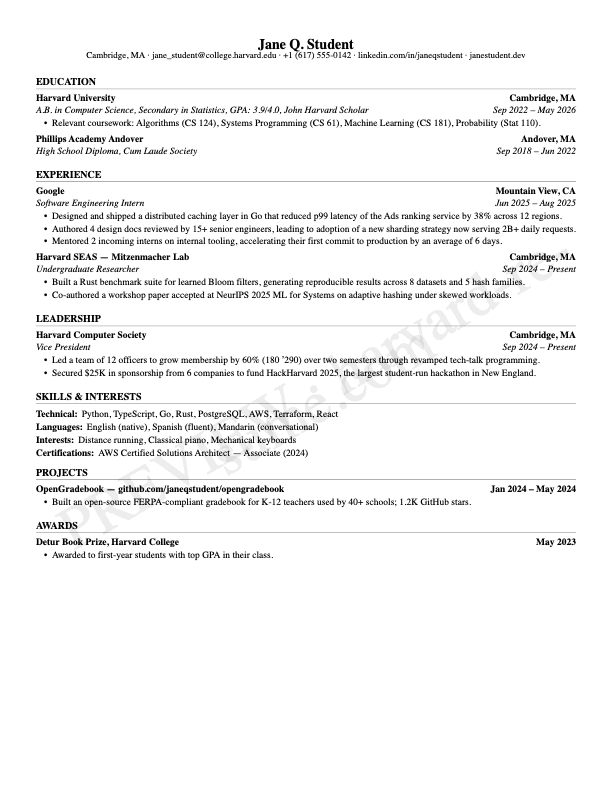
Sample in Harvard format
Strong vs weak bullets
Translated documents from Spanish to English for various clients
Translated 1.2M words of ES>EN clinical-trial documentation (protocols, ICFs, SAE narratives) across 38 projects in Trados Studio; maintained a 99.4% LQA pass rate and zero missed deadlines over 18 months
Names volume, direction, domain, document types, tool, a hard quality metric, and on-time discipline — a life-sciences PM can staff you immediately.
Worked as a medical interpreter at a hospital
Delivered 1,400+ consecutive medical interpreting encounters (ES<>EN) across Oncology, ED, and L&D as a CCHI-certified interpreter; averaged 4.8/5 provider satisfaction and reduced no-show callbacks via accurate discharge instruction relay
Mode + certification + encounter volume + departments + satisfaction score. A language-services manager sees credential, throughput, and patient-facing competence.
Used CAT tools to translate marketing content faster
Localized 320K words of EN>ES marketing and UI copy in Phrase, building a 6,200-segment translation memory and a 900-term glossary that cut downstream MTPE turnaround 35% and lifted DQF quality scores from 88 to 96
Quantifies localization volume, TM/glossary assets built, the throughput gain, and a before/after quality score — shows you make a whole pipeline faster, not just yourself.
Translated legal documents and court papers
Produced certified ES>EN translations of 600+ legal instruments (depositions, MSAs, court filings) with notarized certificates of accuracy; interpreted 90+ court proceedings as a state-certified court interpreter with zero objections sustained on the record
Document count, certification mechanism (certificates of accuracy), interpreting volume, credential, and an unimpeachable quality proxy — exactly what a legal LSP or court coordinator vets for.
Mistakes specific to this role
- Writing 'fluent in Spanish and English' instead of directional pairs with level — recruiters need to know which way you translate and at what proficiency.
- Listing CAT tools as a vague skill ('translation software'). Name Trados, memoQ, Phrase, and your TMS by version or platform; PMs filter on exact tools.
- Omitting your certification body, language pair, and direction. 'Certified translator' is meaningless; 'ATA-certified ES>EN, 2023' is searchable and credible.
- Reporting no volume or quality numbers. Words/day, LQA pass rate, MQM/DQF scores, and interpreting hours are the currency of this field.
- Mixing translation and interpreting into one undifferentiated blob. Separate them — different skills, modes, and certifications, and PMs hire for one or the other.
Your résumé starts here. Pay later.
Start composingFrequently asked
- How do I show my language pairs on a Harvard-format resume?
- Use a dedicated Languages line under your contact block with directional notation and proficiency: 'ES<>EN (native/native), FR>EN (professional)'. Reserve '<>' for pairs you translate both ways and '>' for one-directional. This is the first thing PMs filter on.
- Should translation and interpreting go on the same resume?
- Yes, but in separate sections with their own bullets and metrics. Translation bullets quantify words and LQA scores; interpreting bullets quantify mode (simultaneous/consecutive), setting, and encounter or session counts. Lead with whichever is your stronger revenue stream.
- Which certifications carry the most weight?
- It depends on domain. ATA certification is the gold standard for translation in the US; CCHI/CoreCHI and NBCMI for medical interpreting; FCICE (federal) or state court certification for legal; CIOL DipTrans in the UK. Name the exact body, language pair, direction, and year.
- Do I list machine-translation post-editing (MTPE) experience?
- Yes — it's now standard LSP work. State the engines/platforms and quantify it: 'MTPE of 800K words EN>ES in Phrase, full and light post-editing, sustaining 2,500 words/day'. Many agencies staff MTPE separately from full human translation.