Design · 2026
Harvard Resume for UX Designers
UX hiring runs portfolio + résumé in parallel. The résumé is the 8-second filter where you prove process, scope, and outcomes before anyone opens your case studies.
How do I write a UX Designers resume in the Harvard format?
UX hiring is portfolio-first, but the résumé does the first cut. A design manager or recruiter at companies like Figma, Spotify, Atlassian, Google, or a Series-B startup spends 6-10 seconds scanning for your tools, the scope of products you've shipped, your research depth, and the metrics you moved before they ever open the case-study link. The Harvard one-page format forces you to compress years of double-diamonds and design sprints into exactly the signals that earn that click.
What recruiters look for
- Portfolio URL above the fold, on the contact line — and it must load and be password-free or password-provided
- Real tools named: Figma, FigJam, Maze, Dovetail, ProtoPie, Framer, UserTesting (not 'industry-standard design tools')
- End-to-end process evidence: discovery research, IA, wireframes, prototyping, usability testing, handoff
- Quantified outcomes from research and design: task-completion rate, time-on-task, SUS/NPS lifts, funnel conversion, drop-off reduction, support-ticket deflection
- Design-system contribution named with scale: components built, tokens owned, teams adopting, coverage %
- Accessibility fluency: WCAG 2.2 AA, screen-reader testing, contrast and focus-state work
Required sections, in this order
Header & portfolio placement
- Portfolio URL as the second contact-line entry, right after email — this is the single most important link on the page
- If the portfolio is gated, write the password inline (e.g. 'portfolio.com · pw: review2026') so a busy reviewer never hits a wall
- Optional one-line positioning under your name: 'Senior UX Designer · B2B SaaS · 7 yrs' — skip a 'design philosophy' paragraph entirely
- No photo, no DOB, no marital status — the work and the metrics carry the page
Experience bullets — UX-specific
- Lead with the design problem and the user, not the deliverable ('reduced abandoned checkouts' beats 'designed new checkout screens')
- Quantify research scope explicitly: number of interviews, usability sessions, survey respondents, diary studies
- Pair a quant outcome (a metric you moved) with a qual outcome (an insight that changed the roadmap or killed a feature)
- Show the ship: name the platforms (iOS/Android/web), the engineers and PM you partnered with, and that it actually launched
Skills & methods section
- Tools: 5-8 you use weekly (Figma, FigJam, Maze, Dovetail, ProtoPie, Framer) — not your entire history of apps
- Methods: usability testing, design systems, design tokens, information architecture, journey mapping, WCAG accessibility, ResearchOps
- Adjacent skills only if real: 'production HTML/CSS, light React for prototypes' — never just 'coding'
- Cut soft-skill filler ('user-centric', 'team player'); the bullets must prove these, not the skills list
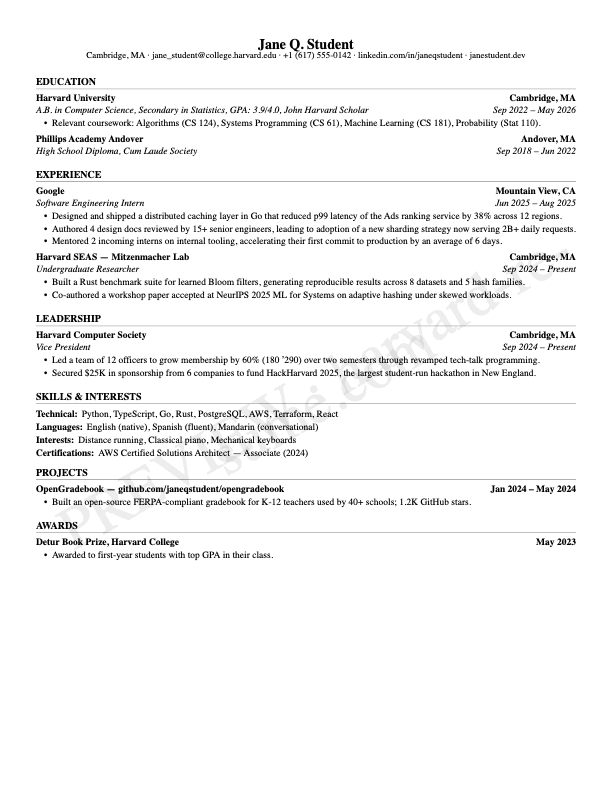
Sample in Harvard format
Strong vs weak bullets
Redesigned the checkout experience to make it easier to use
Redesigned the 4-step mobile checkout for a 3.1M-MAU marketplace; ran 16 moderated usability sessions and a 1,200-respondent unmoderated study that surfaced a hidden shipping-cost objection; cut checkout abandonment from 41% to 27% and lifted conversion-to-paid +9% across iOS and Android within 8 weeks of launch
Names the surface scope (4-step checkout), the user base (3.1M MAU), the research method and depth (16 sessions + 1,200-respondent study), the insight that drove the work, the headline metric (abandonment 41% → 27%), and the platforms. A design manager infers full-cycle ownership in seconds.
Helped build and maintain the company's design system
Co-founded the design system 'Atlas' and grew it from 0 → 72 components with 140 design tokens in 11 months; drove adoption across 6 product teams covering 88% of the app surface; cut average feature design time 34% (measured against 10 reference features) and standardized WCAG 2.2 AA focus and contrast states across all components
Component count, token count, team adoption, surface coverage, a meta-metric with a stated measurement method, and an accessibility signal. Senior reviewers read all of those as evidence of systems thinking, not just screen design.
Did user research to inform product decisions
Ran the discovery phase for a new B2B onboarding flow: 22 stakeholder and customer interviews plus a 5-participant diary study over 2 weeks; synthesized findings into a journey map that killed a planned in-app tutorial and reprioritized self-serve setup, which reduced time-to-first-value from 6 days to 38 hours for new accounts
Quantifies research scope (22 interviews + diary study), shows synthesis (journey map), and demonstrates judgment by naming what the research killed — plus a hard activation metric (time-to-first-value 6 days → 38 hours). It proves research that changed the roadmap, not research for its own sake.
Worked closely with engineers and product managers
Co-led a 3-week design sprint with 1 PM and 4 engineers on a pricing-page redesign; prototyped 5 hypothesis variants in Figma, validated the top 2 with 12 unmoderated tests, then A/B tested the winner against control over 6 weeks for +18% upgrade conversion
Replaces 'collaborated' with a concrete, run-it-yourself shipping story: pod composition, sprint length, variant count, validation method, A/B duration, and the outcome. It reads as a designer who drives the process, not one who decorates it.
Mistakes specific to this role
- Submitting a portfolio link that 404s, is still password-gated with no password, or shows shipped work behind 'request access'. This is the single most common reason a strong UX designer gets auto-rejected.
- Listing deliverables instead of outcomes ('created wireframes and prototypes'). Reviewers assume you can make artifacts; they're scanning for what the artifacts changed.
- A 'design philosophy' or 'I believe great design...' paragraph at the top. Save it for the portfolio about-page; the résumé top-third is for scope and signal.
- Dumping 15+ tools to look thorough. List 5-8 you'd be tested on live in an interview; depth beats breadth.
- Omitting research and accessibility entirely. A UX (not UI) résumé without usability testing or WCAG work reads as a visual designer, and gets routed to the wrong pile.
Your résumé starts here. Pay later.
Start composingFrequently asked
- Should I link a custom portfolio site, a Notion page, or Dribbble/Behance?
- A custom site or a well-structured Notion/Read.cv is best — it signals you can ship and tell a story. Dribbble is fine as a secondary visual link but rarely the primary one for product UX roles; Behance reads dated. Whatever you link, put it on the contact line and include the password inline if it's gated.
- I'm a UX/UI generalist. Should I emphasize research or visual craft?
- Match the job. For product-design and UX-research-heavy roles, lead bullets with research scope and outcome metrics. For UI-leaning roles, you can surface visual systems and the design system work earlier. Keep one bullet per role that shows the other side so you don't read as one-dimensional.
- Where do UX certifications like NN/g, Google UX, or a bootcamp go?
- A one-line entry in Education or a compact 'Certifications' line — not a dedicated section unless you have 3+ that are genuinely recognized (NN/g UX Certification carries weight; a generic course carries little). For career-changers, lean harder on a Projects section with real, testable case studies than on certificate logos.
- How do I show impact when I can't share exact numbers under NDA?
- Generalize the absolute and keep the relative ('lifted task-completion ~20% on a multi-million-MAU consumer app'). Reviewers accept ranges and relative deltas for confidential work; a bullet with no measurement at all is the real problem, not one with a rounded one.