Healthcare · 2026
Harvard Resume for Veterinarians (DVM/VMD)
Veterinary hiring weighs clinical caseload, surgical volume, and patient outcomes. Hospitals read case numbers, not adjectives.
How do I write a Veterinarians (DVM/VMD) resume in the Harvard format?
Veterinary practices and hospital groups hire on demonstrated clinical competence, not warmth alone. A medical director scanning your resume wants caseload numbers, surgical volume, species breadth, and how you handle a busy appointment book without compromising standard of care. This recipe adapts the one-page Harvard format for associate veterinarian, ER/emergency, and specialty (internal medicine, surgery, ECC) applications — and translates your DVM training into the quantified signals hiring committees and recruiters actually rank.
What recruiters look for
- DVM/VMD degree + active state license (DEA registration; specify states)
- Surgical caseload: spay/neuter volume, soft-tissue and orthopedic procedures performed solo vs assisted
- Species mix and appointment throughput (e.g. 18-22 small-animal cases/day) with patient outcomes
- Diagnostic fluency: digital radiography, ultrasound (AFAST/TFAST), in-house chemistry/CBC, cytology interpretation
- Board certification or residency (ACVS, ACVIM, ACVECC) or internship completion (rotating/specialty)
- PIMS/PMS proficiency (Cornerstone, AVImark, ezyVet) and Fear Free / low-stress handling certification
Required sections, in this order
Credentials and licensure block
- Lead with DVM/VMD, school, and year; list active licenses by state plus DEA registration status
- Surface NAVLE pass and any internship/residency completion (rotating internship, specialty internship, residency program + institution)
- List board status precisely: 'ACVS Diplomate' vs 'ACVS resident-in-training' vs 'practice-eligible' — never blur the line
- Add Fear Free Certified, AVMA membership, and state VMA membership as compact one-liners
Clinical Experience section
- Quantify caseload per role: appointments/day, surgeries/week, and species split (e.g. 70% canine/feline, 20% exotics, 10% emergency)
- Separate medicine from surgery bullets; name procedures you perform independently (e.g. enterotomy, cystotomy, splenectomy, TPLO-assist)
- State outcome metrics where you have them: anesthetic complication rate, post-op infection rate, client compliance/follow-up rate
- Show productivity and revenue signal honestly (ATC — average transaction charge, monthly production) without sounding mercenary
Education, research, and continuing education
- Education first with clinical rotations or honors (Phi Zeta) if strong; list class rank only if top quartile
- Group publications, case reports, and conference presentations (VMX, WVC, ACVIM Forum) under a single Research/Presentations line
- List CE depth selectively — advanced certifications (TPLO/TTA, dentistry, ultrasound) beat a long list of webinar hours
- Keep to one page; a second page is justified only for specialists with a substantial publication record
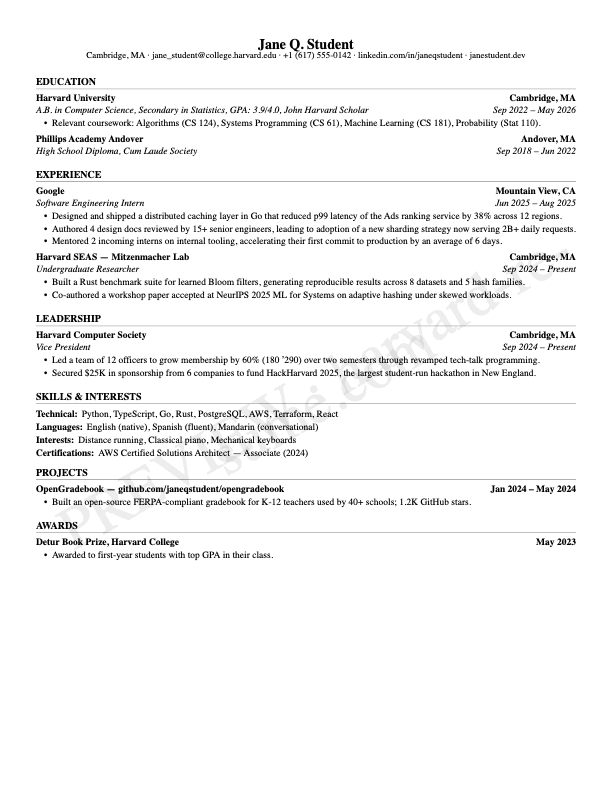
Sample in Harvard format
Strong vs weak bullets
Performed surgeries and saw appointments at a busy animal hospital
Managed an 18-22 patient/day small-animal caseload at a 4-doctor AAHA-accredited practice while performing 12-15 soft-tissue surgeries/week (spay/neuter, mass removal, cystotomy, enterotomy); held anesthetic complication rate under 1.5% across 600+ procedures
Names daily throughput, surgical volume and specific procedures, practice accreditation, and a real outcome metric (anesthetic complication rate) over a stated case count.
Helped improve client compliance and follow-up at the clinic
Redesigned the post-op discharge workflow and parasite-prevention protocol, lifting client compliance on recommended diagnostics from 54% to 78% and 6-month preventive-refill rate from 41% to 63% across ~1,400 active patients
Quantifies before/after on two distinct compliance metrics at a named patient scale, and credits a concrete process change you owned.
Worked emergency shifts and stabilized critical patients
Covered overnight ER as sole doctor for a 24-hour hospital, triaging 14-20 emergencies/shift; led GDV, HBC, and toxicity stabilizations including AFAST/TFAST, jugular catheter placement, and CPR per RECOVER guidelines, achieving 38% ROSC on arrested patients vs 26% prior-year baseline
Shows solo-doctor responsibility, emergency volume, named critical procedures, guideline literacy (RECOVER), and a benchmarked survival metric.
Trained and mentored new staff and technicians
Built and led a 6-week onboarding curriculum for 9 credentialed technicians on anesthesia monitoring and dental radiography; reduced anesthetic recovery incidents by 40% and cut average dental procedure time from 95 to 68 minutes over two quarters
Names the audience, scope, and duration, then ties mentorship to two measurable clinical and efficiency outcomes rather than vague 'leadership'.
Mistakes specific to this role
- Listing 'compassionate, dedicated animal lover' adjectives instead of caseload, surgical volume, and outcome numbers.
- Blurring board status — writing 'ACVS' when you are practice-eligible or a resident-in-training is a credibility killer with medical directors.
- Omitting species mix and appointment throughput, so a hiring DVM can't gauge whether your pace matches their book.
- Dumping every CE webinar as a line item; surface only advanced procedural certifications (TPLO, ultrasound, dentistry).
- Hiding licensure and DEA status at the bottom — recruiters screen on state license eligibility first.
Your résumé starts here. Pay later.
Start composingFrequently asked
- Should I list my NAVLE score?
- No. A passing NAVLE is binary — list that you passed, not the score. Hospitals care about clinical caseload and references, not the number.
- How do I show surgical numbers if I'm a new graduate from a rotating internship?
- Quantify what you actually did during clinical rotations and internship: 'assisted 40+ orthopedic procedures, performed 30 spay/neuter independently.' Distinguish 'performed' from 'assisted' honestly — internship directors and associates verify this.
- Do I include production or revenue numbers?
- Yes, tastefully. Average transaction charge and monthly production signal you understand practice economics. Pair it with a care-quality metric so it reads as competence, not just billing.
- How do I list multiple state licenses for a relief/locum role?
- Put them in the credentials block: 'Licensed: CA, TX, AZ (active); DEA registered.' For relief work, breadth of active licenses is a direct hiring signal — surface it near the top.