Software · Web · 2026
Web Developer Resume (Harvard Format)
Ship a Harvard-format resume that proves you build fast, accessible, reliable web apps — not just that you know React.
How do I write a Web Developer Resume (Harvard Format) resume in the Harvard format?
Hiring teams skim a Web Developer resume in seconds looking for proof you ship production features that load fast, stay accessible, and don't break under traffic. The Harvard format forces one page of metric-backed bullets — LCP and INP numbers, test coverage, bundle-size cuts, conversion lift — instead of a wall of framework logos. This guide shows you how to turn 'built a React app' into evidence a senior engineer would respect.
What recruiters look for
- Core Web Vitals fluency: concrete LCP, INP/FID, and CLS targets you hit (e.g. LCP under 2.5s, INP under 200ms) measured in Lighthouse or real-user monitoring (CrUX, Vercel Speed Insights)
- Modern stack depth, not just buzzwords — React/Next.js or Vue/Nuxt, TypeScript, a state layer (Redux Toolkit, Zustand, TanStack Query), and CSS strategy (Tailwind, CSS Modules)
- Accessibility ownership: WCAG 2.2 AA conformance, semantic HTML, ARIA used correctly, axe/Lighthouse a11y scores, keyboard and screen-reader testing
- Testing and CI signals: Jest/Vitest unit coverage %, Playwright/Cypress E2E, and green CI gates that block regressions before merge
- Performance and DX wins with numbers: bundle-size reductions (KB shipped), build-time cuts, p75 latency, cache-hit ratios on the CDN
- Shipped business impact: features tied to conversion, signups, retention, or revenue — A/B-tested where possible, not just 'developed the UI'
Required sections, in this order
Header & Technical Skills That Pass the 6-Second Scan
- Put a clean header: name, one-line title (e.g. 'Frontend Engineer · React/TypeScript'), city/timezone, email, GitHub, portfolio URL, and LinkedIn — no full street address.
- Group skills by category so a recruiter parses them instantly: Languages (TypeScript, JavaScript, HTML, CSS), Frameworks (Next.js, React), Tooling (Vite, Webpack, Playwright), Platform (Vercel, AWS, Docker).
- List only tools you can defend in an interview — drop the 14-logo skills dump; depth in 6 technologies beats shallow exposure to 20.
- Mirror the exact stack keywords from the job description so you survive ATS keyword filters without keyword-stuffing.
Experience Bullets in the Harvard XYZ Formula
- Use 'Accomplished [X] as measured by [Y] by doing [Z]' — every bullet leads with an outcome and a number, not a task.
- Quantify front-end-specific metrics: LCP/INP milliseconds, Lighthouse scores, bundle KB, test coverage %, error-rate drops, conversion or signup lift.
- Show scope: daily active users, requests per second, number of components/pages migrated, team size, or codebase LOC you owned.
- Name the technology inside the bullet (Next.js App Router, React Server Components, TanStack Query) so the 'how' is concrete and searchable.
Projects, Open Source & Education
- For junior or bootcamp grads, a Projects section carries weight: 2-3 deployed apps with live links, the stack, and one quantified result each (Lighthouse 98, 1.2s LCP).
- Cite open-source contributions with specifics: merged PRs, the repo, stars, or issues resolved — links a reviewer can click.
- Keep Education concise: degree or bootcamp, institution, year; add relevant coursework or a meaningful capstone only if you're early-career.
- List credentials that actually signal web depth (e.g. AWS Certified Developer, freeCodeCamp Responsive Web Design) and skip generic 'completion' badges.
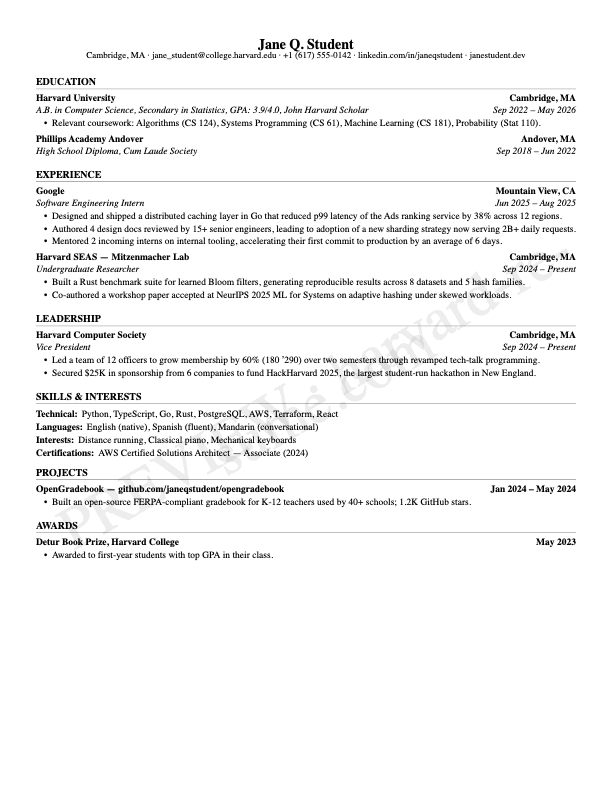
Sample in Harvard format
Strong vs weak bullets
Worked on the company website to make it faster.
Cut homepage LCP from 4.1s to 1.6s and raised the Lighthouse performance score from 52 to 96 by code-splitting the React bundle, lazy-loading below-the-fold images, and serving AVIF via a CDN — lifting mobile conversion 11%.
Names the exact metric (LCP), before/after numbers, the technical levers, and ties it to a business outcome (conversion).
Built reusable components for the frontend team.
Built a 40-component TypeScript design system in Storybook adopted by 5 product teams, cutting net-new UI build time ~30% and eliminating 1,200+ lines of duplicated CSS across 3 repositories.
Quantifies adoption (5 teams), effort saved (~30%), and code deleted — showing leverage, not just output.
Improved accessibility on the checkout flow.
Brought the checkout flow to WCAG 2.2 AA conformance — raising the axe-core a11y score from 71 to 100 by fixing focus order, ARIA labels, and 3.1:1 contrast failures — and validated with NVDA and keyboard-only testing across 8 screens.
Cites the standard (WCAG 2.2 AA), the tooling (axe-core, NVDA), a measurable score, and the verification method.
Helped migrate the app to Next.js.
Led the migration of a 60-page React SPA to the Next.js App Router with React Server Components, reducing client JS shipped by 38% (210KB → 130KB gzipped) and improving p75 INP from 240ms to 150ms for 80K monthly users.
Shows ownership (led), scale (60 pages, 80K users), and two hard metrics (KB shipped, INP) with the specific technology.
Mistakes specific to this role
- Listing frameworks with no outcomes — a 20-logo skills wall tells a recruiter nothing about whether your code shipped or performed.
- Vague verbs like 'worked on', 'helped with', or 'responsible for' instead of 'built', 'shipped', 'reduced', 'led' with a number attached.
- Ignoring performance and accessibility entirely — these are the two front-end signals senior reviewers most often probe, and a resume silent on both reads as junior.
- Spilling onto two pages or pasting a code block — Harvard format is strictly one page; depth comes from sharper bullets, not more of them.
- Claiming 'expert' in 15 technologies; an interviewer will pick the weakest one and the inflation costs you credibility fast.
Your résumé starts here. Pay later.
Start composingFrequently asked
- Should a Web Developer resume include a portfolio or GitHub link?
- Yes — for front-end roles it's often the first thing a reviewer clicks. Put a live portfolio URL and GitHub in the header. Make sure linked projects are deployed and fast (your own site's Lighthouse score is a silent interview), and pin 2-3 strong repos rather than exposing 40 abandoned ones.
- How do I write a Web Developer resume with no professional experience?
- Lead with a Projects section of 2-3 deployed apps, each with a live link, the stack, and one quantified result (Lighthouse 95+, sub-2s LCP, 90% test coverage). Add freelance or open-source work, a bootcamp or CS degree, and relevant certs. Recruiters care more about what you've shipped than where you were employed.
- Front-end, back-end, or full-stack — how specific should the title be?
- Match the job you're applying to. If the role says 'Frontend Engineer', title yourself that and front-load React/TypeScript/CWV bullets; for full-stack, balance UI bullets with API, database, and deployment wins. A title that mirrors the posting helps both the ATS and the human skimming it.
- Which metrics matter most on a Web Developer resume?
- The ones a senior engineer respects: Core Web Vitals (LCP, INP, CLS), bundle size in KB, Lighthouse and accessibility scores, test coverage %, error-rate or p75 latency reductions, and business outcomes like conversion or signup lift. Always pair the technical metric with the user or revenue impact.